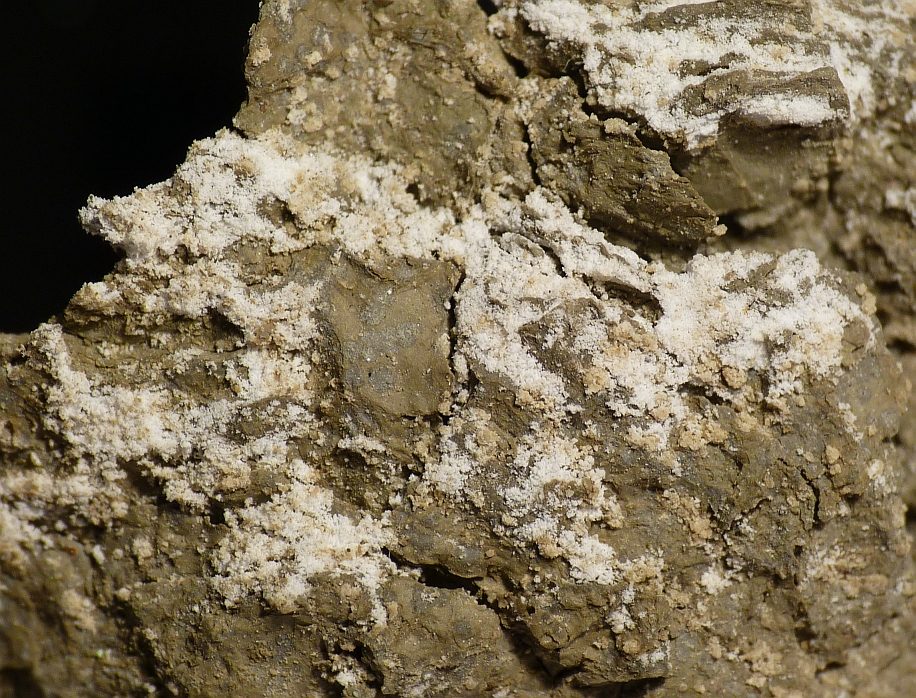
Brushite , Montmorillonite Locality: Røjle Klint, Fyns Amt, Fyn, Southern Denmark Region, Denmark White tiny brushite crystals on grayish massive montmorillonite. Ex Claus Hedegaard collection. Field of view 2 cm. — Photo: Leon Hupperichs · CC BY-SA 3.0
Brushite
A hydrated calcium hydrogen phosphate; the phosphate counterpart of the arsenate pharmacolite.
Intro adapted from Wikipedia (CC BY-SA).
Brushite is an IMA-recognized mineral species in the phosphate class, with the chemical formula Ca(PO₃OH)·2H₂O.
It crystallizes in the monoclinic crystal system (space group Ia). It is a member of the Gypsum structural group.
Key properties: Mohs hardness 2.5; specific gravity 2.328; Vitreous, pearly on cleavages luster; refractive index 1.545; optically biaxial.
IMA symbol Bsh, grandfathered status — known before the IMA’s founding, named in 1865.
One of the most common cave minerals, in guano deposits, and in phosphorites, formed at low pH by reaction of phosphate-rich solutions with calcite and clay.
It is found associated with Tanarakite, ardealite, hydroxylapatite, variscite, gypsum.
The mineral was named to honor Professor George Jarvis Brush (1831–1912), American mineralogist, Yale University, New Haven, Connecticut, USA.