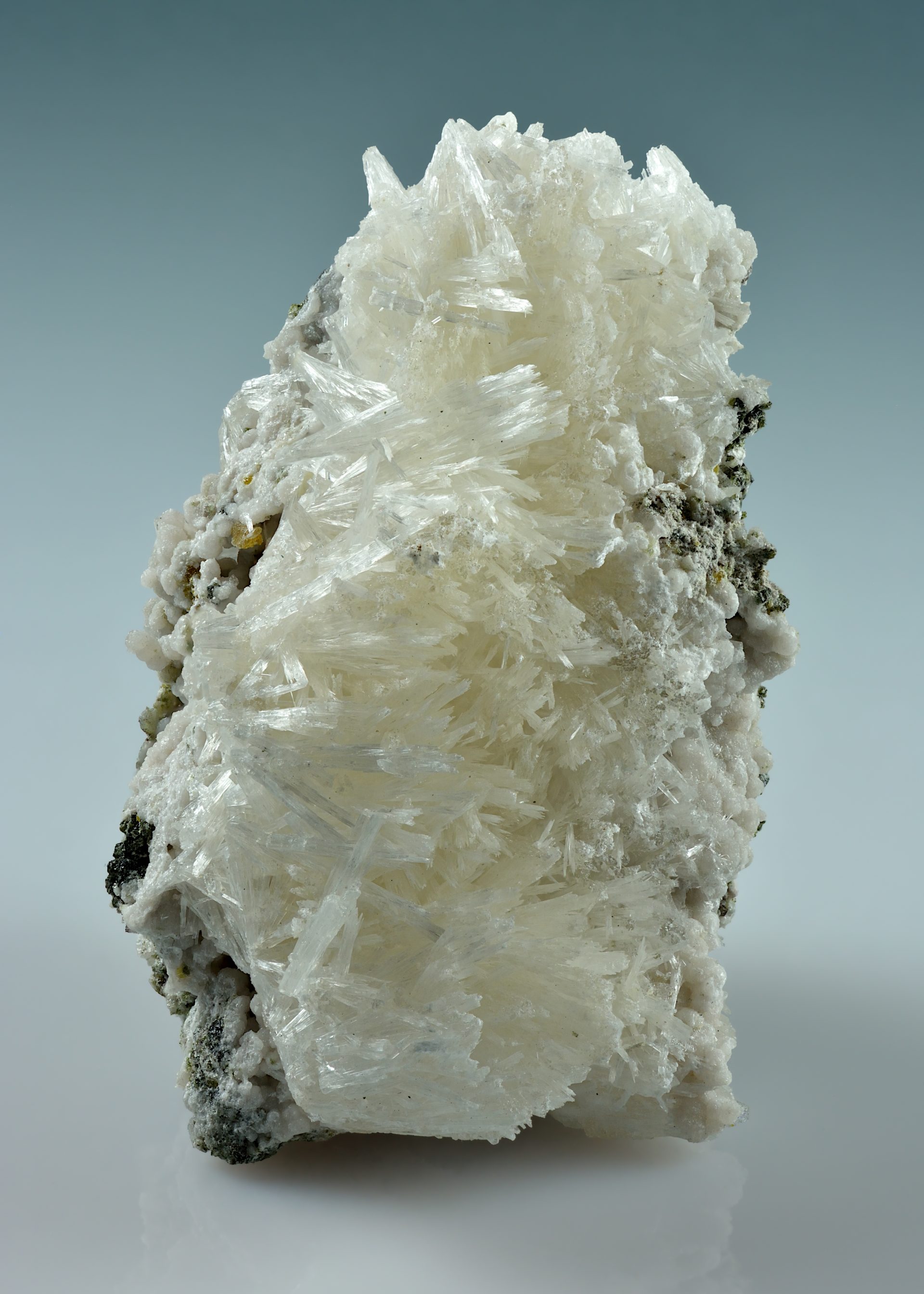
Bultfonteinite (5.0 × 3.0 × 3.0 cm) with minor datolite (small spherical crystal groupings) from Shijiangshan mine, Linxi, Chifeng City, Inner Mongolia, China. — Photo: Ivar Leidus · CC BY-SA 4.0
Bultfonteinite
A pink to colorless calcium silicate hydroxide-fluoride discovered around 1903 at South Africa's Bultfontein mine.
Intro adapted from Wikipedia (CC BY-SA).
Bultfonteinite is an IMA-recognized mineral species in the silicate class, with the chemical formula Ca₂SiO₃(OH)F·H₂O.
It crystallizes in the triclinic crystal system (space group P-1). It is a member of the Spurrite-Afwillite structural group.
Key properties: Mohs hardness 4.5; specific gravity 2.73; Vitreous luster; refractive index 1.591; optically biaxial.
IMA symbol Bul, grandfathered status — known before the IMA’s founding, named in 1932.
Found in a large \horse" of diabase and shale fragments in a kimberlite pipe (Bultfontein mine, Kimberley, South Africa); in a contact zone in thermally metamorphosed limestone (Crestmore, California, USA).
It is found associated with Calcite, apophyllite, natrolite (Bultfontein mine, Kimberley, South Africa); afwillite, scawtite (Crestmore, California, USA); oyelite, scawtite.
The name refers to the Bultfontein mine, Kimberley, South Africa, where it was first discovered.