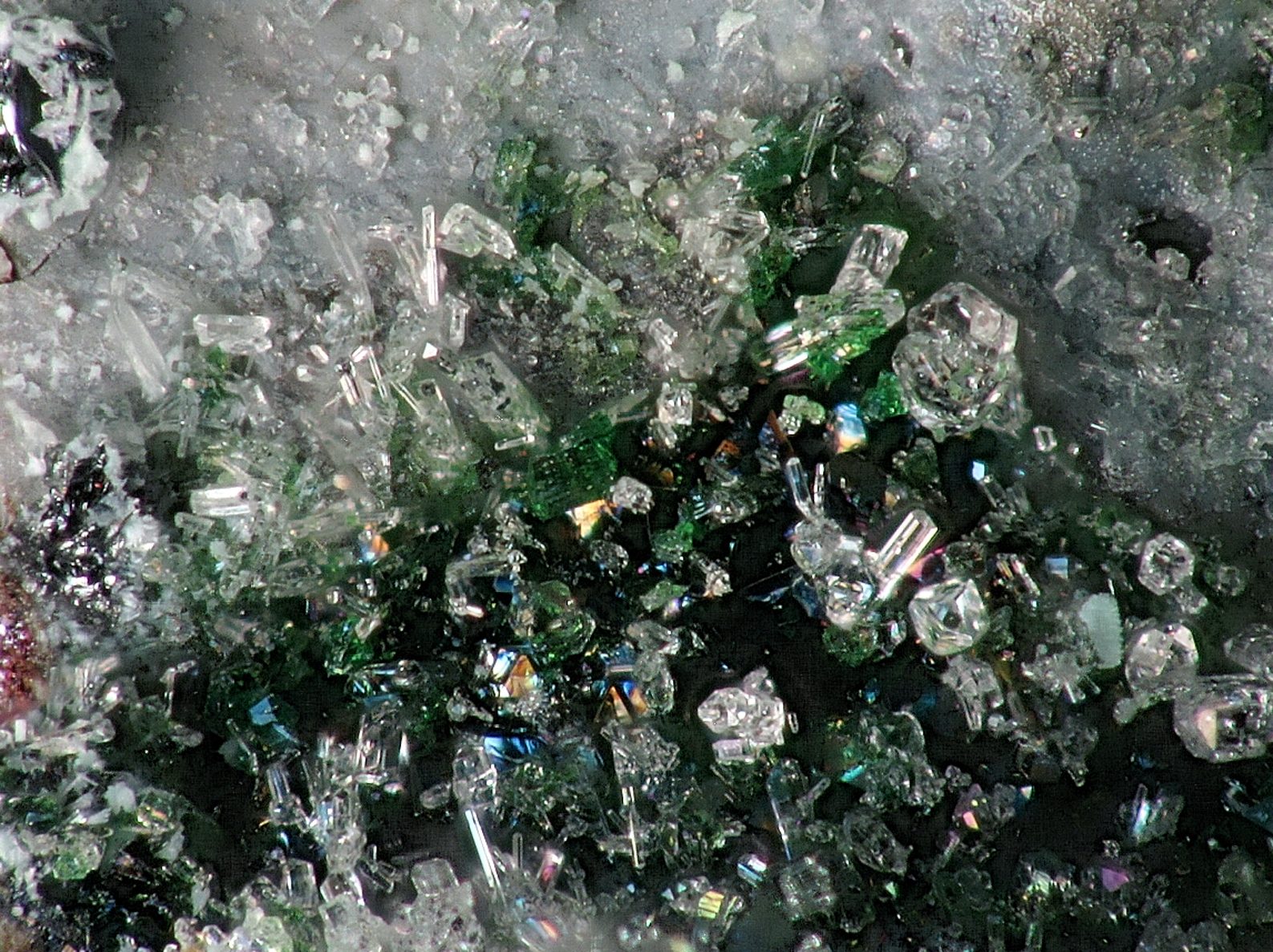
Bunsenite Locality: Kochhütte, Helbra, Mansfeld-Südharz, Saxony-Anhalt, Germany Green blocky crystals and unknown colorless crystals from the collection of the „Verein zur Förderung der Lithothek e.V.“ Munich (collection number A022658). Field of view 1 mm — Photo: Hannes Osterhammer · CC BY-SA 3.0 de
Bunsenite
Natural nickel(II) oxide — rare dark-green cubic crystal coatings.
Intro adapted from Wikipedia (CC BY-SA).
Bunsenite is an IMA-recognized mineral species in the oxides & hydroxide class, with the chemical formula NiO.
It crystallizes in the cubic crystal system (space group Fm3m). It is a member of the Rocksalt structural group.
Key properties: Mohs hardness 5.5; specific gravity 6.898; Brownish black streak; Vitreous luster; refractive index 2.37; optically isotropic.
IMA symbol Bse, grandfathered status — known before the IMA’s founding, named in 1868.
Found in a hydrothermal Ni–U vein (Johanngeorgenstadt, Germany); in a small tabular nickel deposit at the contact between quartzite and serpentinized ultramafics; it apparently formed at ∼730 ° C and < 2 kbar during thermal metamorphism.
It is found associated with Bismuth, annabergite, aerugite, xanthiosite (Johanngeorgenstadt, Germany); liebenbergite, trevorite, nickeloan serpentine, nickeloan ludwigite, violarite.
The name refers to Professor Robert William Eberhard Bunsen (1811–1899), German chemist of the University of Heidelberg, Heidelberg, Germany, who had observed artificial NiO.