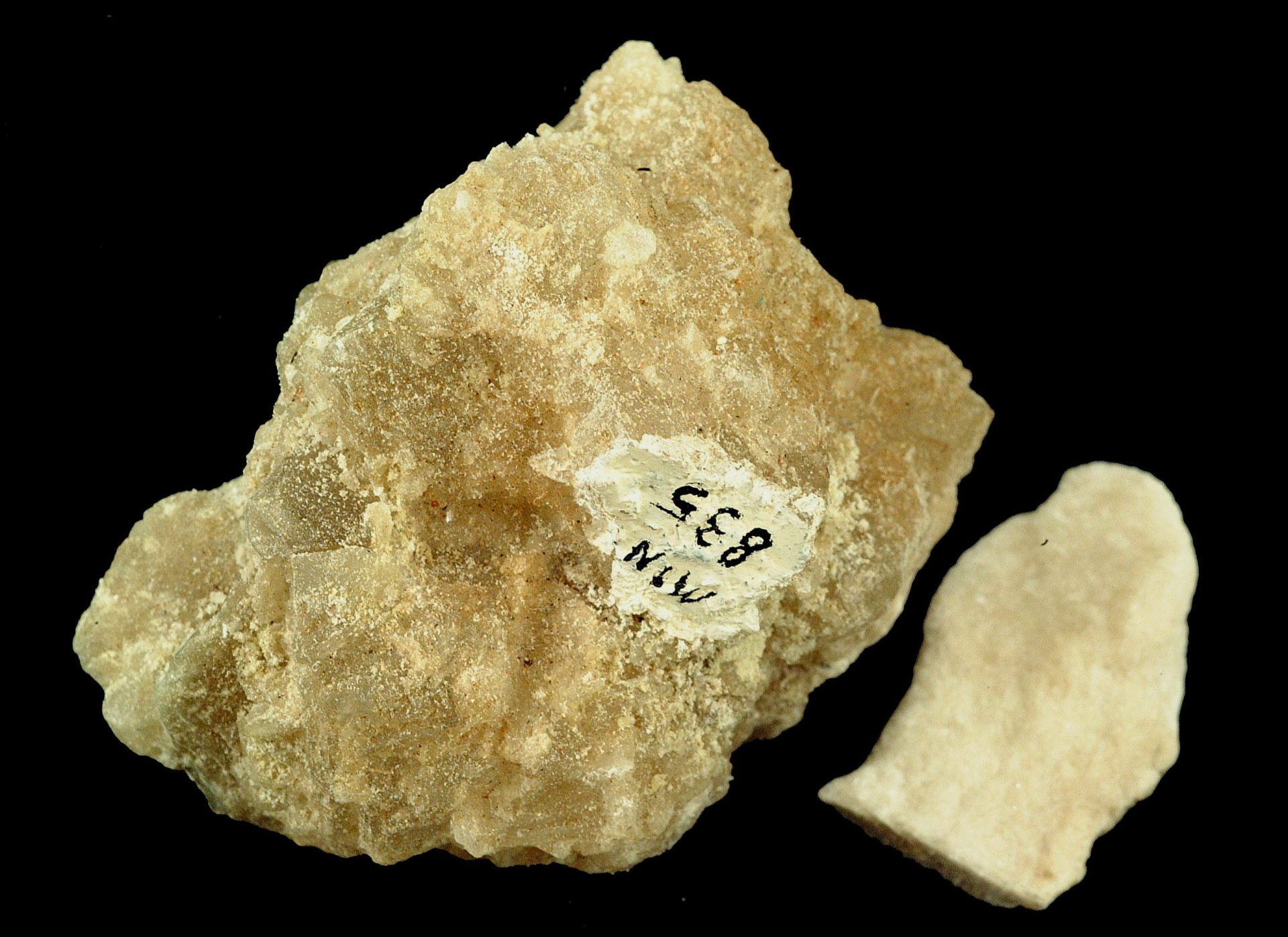
Burkeite is a carbonate-sulfate mineral found in lake clays at Searles Lake, California. It has formula Na6(CO3)(SO4)2. Searles Lake is a playa lake (salty, alkali rich and mostly dry) known for its many rare and unusual evaporite minerals. Most are very soluble in water, so they may have only short life times. The largest of these two specimens is 7 cm across. — Photo: Darla Sondrol · CC0
Burkeite
Burkeite is an IMA-recognized mineral species in the sulfate class, with the chemical formula Na₄(SO₄)(CO₃).
It crystallizes in the orthorhombic crystal system (space group Pmnm).
Key properties: Mohs hardness 3.5; specific gravity 2.57; Vitreous to greasy luster; optically biaxial.
IMA symbol Bke, grandfathered status — known before the IMA’s founding, named in 1921.
An uncommon product of evaporation in dry lakes, but typical of efflorescences on saline soils.
It is found associated with Gaylussite, trona, sulfohalite, borax, northupite, thénardite, calcite, tychite, halite, hanksite (Searles Lake, California, USA).
The mineral was named to honor William Edmund Burke (1880–1966), chemical engineer, who first prepared the synthetic compound.