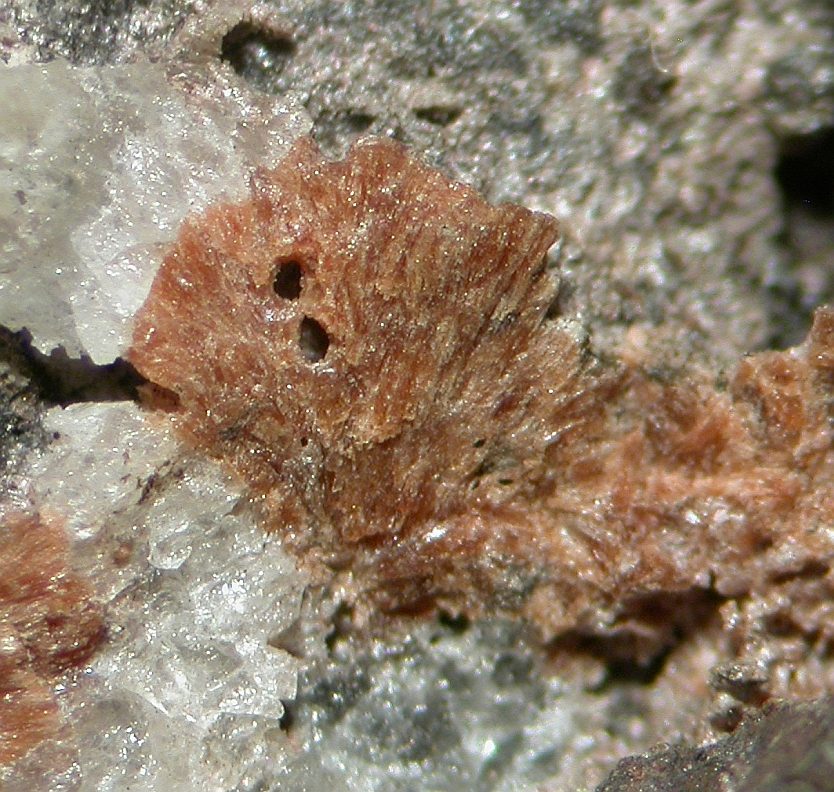
Cabalzarite Locality: Falotta, Tinizong (Tinzen), Oberhalbstein (Surses; Sursass), Albula Valley, Grischun (Grisons; Graubünden), Switzerland Field of view 4 mm. — Photo: Leon Hupperichs · CC BY-SA 3.0
Cabalzarite
A rare hydrated calcium-magnesium arsenate of the tsumcorite group, forming monoclinic crystal clusters.
Intro adapted from Wikipedia (CC BY-SA).
Cabalzarite is an IMA-recognized mineral species in the arsenate class, with the chemical formula CaMg₂(AsO₄)₂·2H₂O.
It crystallizes in the monoclinic crystal system (space group C2/m). It is a member of the Natrochalcite structural group.
Key properties: Mohs hardness 5; specific gravity 3.89; Colorless streak; Vitreous luster; refractive index 1.73; optically biaxial.
IMA symbol Clz, IMA status: approved, named in 1997.
Formed by hydrothermal remobilization of arsenic during retrograde metamorphism, under lowest to sub-greenschist facies conditions, of syn-sedimentary exhalative Mn deposits embedded in radiolarites.
It is found associated with Quartz, adularia, kutnohorite, tilasite, grischunite, arseniosiderite, tripuhyite, Mn- oxyhydroxides (rancieite-takanelite), arsenogoyazite.
The mineral was named to honor Walter Cabalzar (b. 1919) an amateur Swiss collector, who participated in the description of two new minerals from Falotta (grischunite and geigerite).