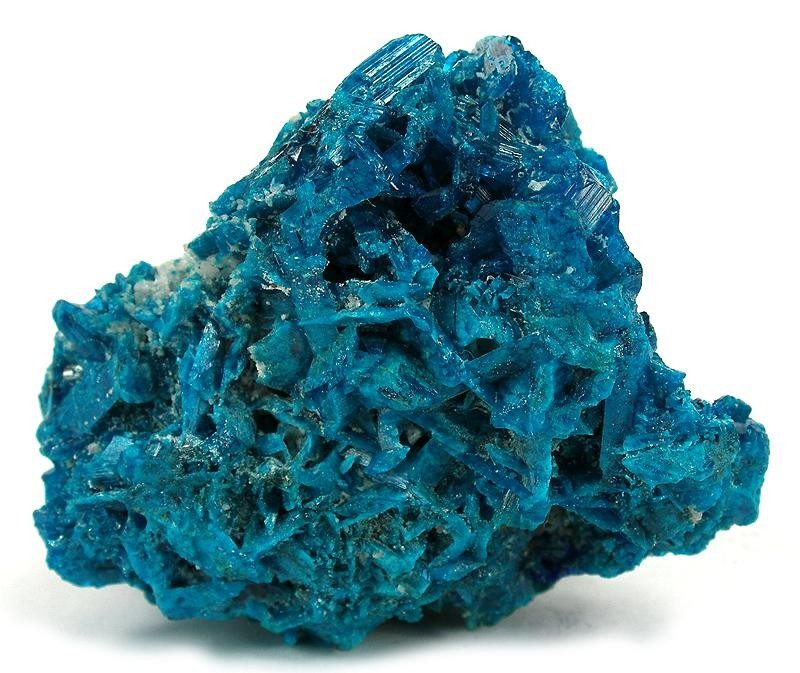
Caledonite , Diaboleite Locality: Mammoth-Saint Anthony Mine (Mammoth-St Anthony Mine; Mammoth Mine; St. Anthony Mine), St. Anthony deposit, Tiger , Mammoth District, Pinal County , Arizona , USA ( Locality at mindat.org ) Size: 5.0 x 4.2 x 2.6 cm. This is a superb specimen. It is solid caledonite, with sharp crystals poking out all over, and with minor deeper blue Diaboleite crystals on the backside. It is likely that this piece was mined prior to 1960. Ex. American Museum of Natural History and Larry Conklin Collections. — Photo: Robert M. Lavinsky · CC BY-SA 3.0
Caledonite
A richly colored blue-green lead-copper sulfate-carbonate named for Caledonia — Scotland, its place of discovery.
Intro adapted from Wikipedia (CC BY-SA).
Caledonite is an IMA-recognized mineral species in the sulfate class, with the chemical formula Cu₂Pb₅(SO₄)₃(CO₃)(OH)₆.
It crystallizes in the orthorhombic crystal system (space group Pmn2_1).
Key properties: Mohs hardness 2.5–3; specific gravity 5.6–5.76; Pale green streak; Vitreous to resinous luster; refractive index 2.498; optically biaxial.
IMA symbol Cdo, grandfathered status — known before the IMA’s founding, named in 1832.
Occurs as an uncommon secondary mineral in the oxidized portions of Pb–Cu deposits.
It is found associated with Cerussite, anglesite, leadhillite, brochantite, linarite, azurite, malachite.
The name comes from the Latin Caledonia, the Roman name for the Highlands of Scotland, the first known locality.