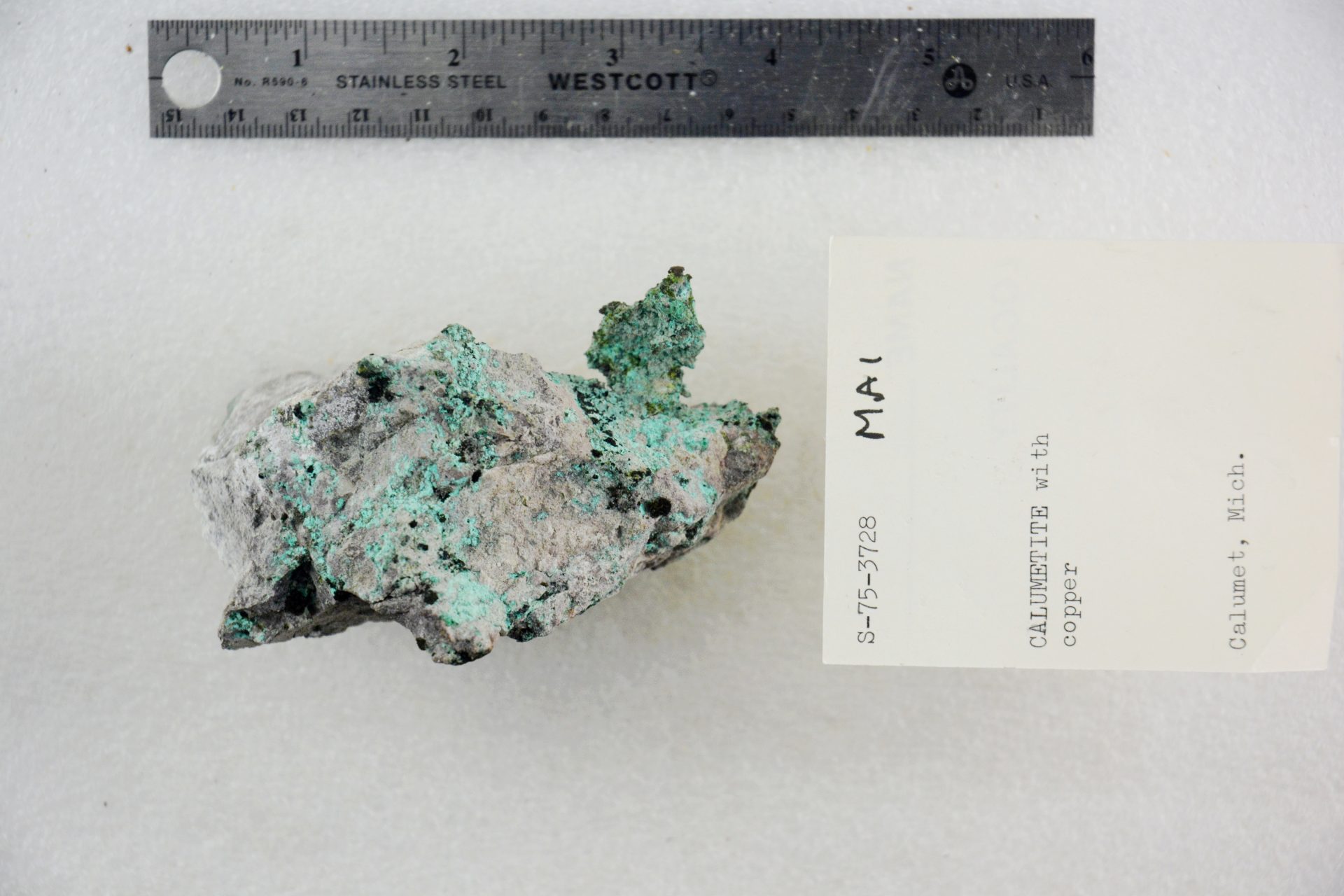
Centennial #2 Mine - Calumet Michigan, USA — Photo: Pacific Museum of Earth from Canada · CC BY-SA 2.0
Calumetite
A rare copper halide discovered in 1963 at Michigan's Centennial Mine alongside anthonyite.
Intro adapted from Wikipedia (CC BY-SA).
Calumetite is an IMA-recognized mineral species in the halide class, with the chemical formula CaCu₄(OH)₈Cl₂·3.5H₂O.
It crystallizes in the orthorhombic crystal system (space group Cmcm). It is a member of the Anthonyite structural group.
Key properties: Mohs hardness 2; Pearly on the cleavage luster; optically biaxial.
IMA symbol Clu, IMA status: approved, named in 1963.
Found in cavities and fractures in basalt, formed by the action of chlorine-bearing connate waters on copper, cuprite being regarded as an intermediate product in the alteration (Centennial mine, Michigan, USA).
It is found associated with Tremolite, quartz, epidote, monazite, copper, cuprite, atacamite, buttgenbachite, malachite, paratacamite, anthonyite (Centennial mine, Michigan, USA).
The name refers to the town of Calumet, Michigan, USA, near which it was first discovered.