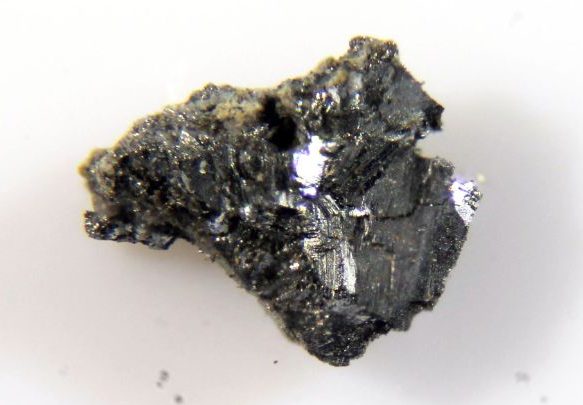
Grey metallic single crystal of the extremely rare Cu-Ag telluride mineral cameronite from Good Hope Mine, Vulcan, Gunnison County, Colorado, United States of America. Ex Vandenbroucke Museum collection from Waregem, Belgium. — Photo: David Hospital · CC BY-SA 4.0
Cameronite
Cameronite is an IMA-recognized mineral species in the sulfide class, with the chemical formula Cu₅₋ₓ(Cu,Ag)₃₊ₓTe₁₀ (x = 0.43).
It crystallizes in the monoclinic crystal system (space group C2/c).
Key properties: Mohs hardness 3.5–4; specific gravity 7.144; Black streak; Metallic luster.
IMA symbol Cme, IMA status: approved, named in 1984.
One of a number of metallic tellurium-bearing minerals in a hydrothermal deposit.
It is found associated with Tellurium, rickardite, vulcanite, arsenopyrite, pyrite.
In honor of Professor Eugene Nathan Cameron (1910–), University of Wisconsin, who first recognized the mineral as a new species.