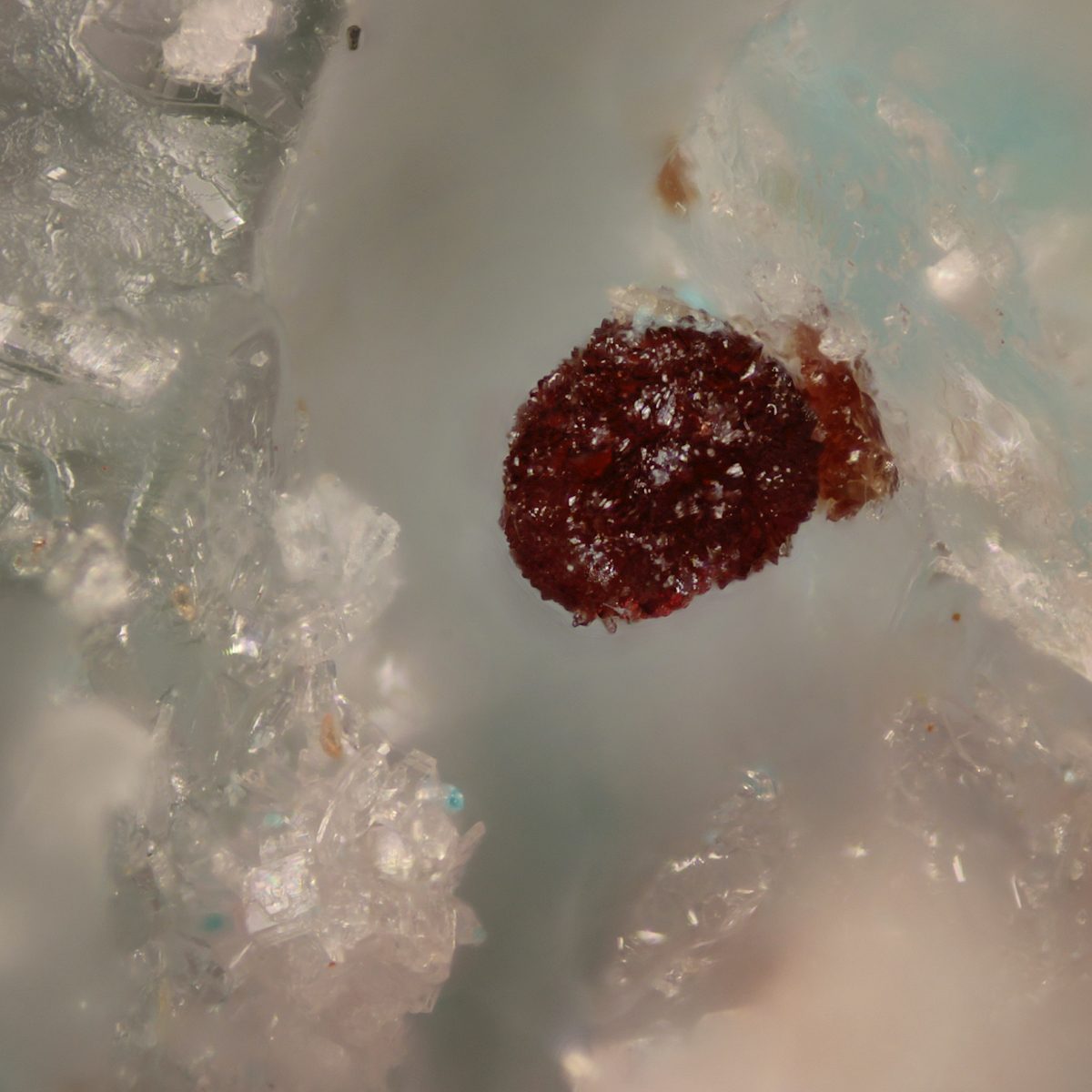
:Locality: Torrecillas Mine, Salar Grande, Iquique, Tarapacá Region, Chile Size: 3.7 × 3 × 1.8 cm Description: Really interesting sample of canutite, a rare sodium and manganese arsenate, formed by several groups of brilliant, transparent and brown color crystal aggregates. They are accompanied by light blue lavendulan, cubic crystals of halite and pinkish magnesiokoritnigite. Canutite and magnesiokoritnigite have the Type Locality in this mine (rather number of small prospects), close to magnesiocanutite that is visually not distinguishable from canutite. A complete and representative specimen. — Photo: Joan Rosell , from rosellminerals.com · CC BY-SA 4.0
Canutite
Canutite is an IMA-recognized mineral species in the arsenate class, with the chemical formula Na MnMn₂(AsO₄)[AsO₃(OH)]₂.
It crystallizes in the monoclinic crystal system (space group C2/c). It is a member of the Alluaudite structural group.
Key properties: Mohs hardness 2.5; specific gravity 4.112; Pale tan streak; Vitreous luster; optically biaxial.
IMA symbol Can, IMA status: approved, named in 2013.
A secondary mineral from the oxidation of native arsenic and other As-bearing primary phases, followed by later alteration by saline fluids derived from evaporating meteoric water under hyperarid conditions.
It is found associated with Anhydrite, halite, lavendulan, magnesiokoritnigite, pyrite, quartz, scorodite.
The mineral was named to honor Claudio Canut de Bon Urrutia (b. 1937), Chilean mining engineer and Senior Professor of Geology and Mineralogy, La Serena University, Coquimbo Region, Chile.