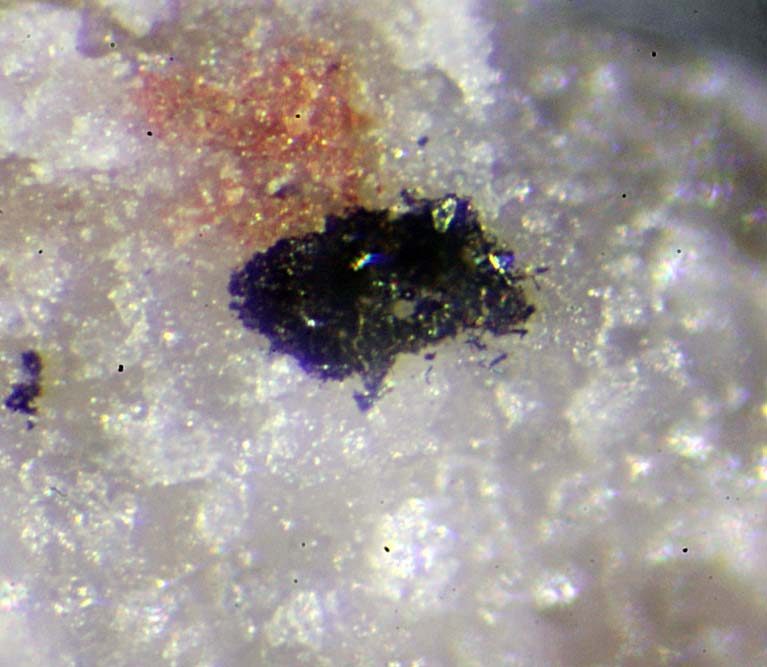
A lot of small almost black microcrystals of the extremely rare capgaronnite in a white contrasting matrix. From: Frischer Muth Mine, Eiserfeld, Siegen, Siegerland, Rhineland-Palatinate, Germany. Capgaronnite has only been found in six localities worldwide. It is one of the very few minerals with Bromine (Br) and Iodine (I) in its composition. In fact, from more than 5500 known minerals, only 17 have Bromine in its composition, only 26 have Iodine and only 6 have Bromine and Iodine at the same time in its composition (from MINDAT database), so this is a real rarity! Analyzed specimen. — Photo: David Hospital · CC BY-SA 4.0
Capgaronnite
A mercury sulfide-silver halide forming tufts and crystals barely a tenth of a millimetre long.
Intro adapted from Wikipedia (CC BY-SA).
Capgaronnite is an IMA-recognized mineral species in the sulfide class, with the chemical formula AgHgClS.
It crystallizes in the orthorhombic crystal system (space group P2_12_12).
Key properties: specific gravity 6.19; Gray-black streak; Subadamantine to submetallic luster; optically biaxial.
IMA symbol Cga, IMA status: approved, named in 1990.
Probably formed from oxidation of Hg–Ag-rich tennantite exposed to seawater (Cap Garonne mine, France).
It is found associated with Olivenite, cyanotrichite, brochantite, parnauite, tennantite, strüverite, tourmaline, perroudite.
The name refers to the occurrence in the Cap Garonne mine, France.