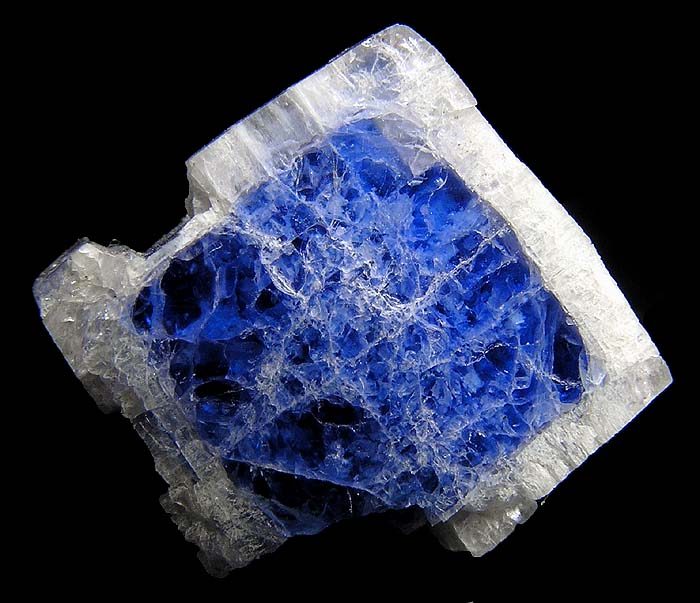
Carletonite Locality: Poudrette quarry (Demix quarry; Uni-Mix quarry; Desourdy quarry), Mont Saint-Hilaire , Rouville RCM, Montérégie , Québec , Canada ( Locality at mindat.org ) A very large example for this form of carletonite, which, due to its size has also acquired an opacity not common to the others here. It is a bit rough-looking and is missing one corner at the bottom. The demarcation between blue and white is so sharp and distinct. 1.6 x 1.6 x 0.9 cm . This Photo was Mindat.org Photo of the Day - 3rd Oct 2006 — Photo: Robert M. Lavinsky · CC BY-SA 3.0
Carletonite
A rare blue phyllosilicate — potassium-sodium-calcium carbonate-silicate — forming translucent tetragonal crystals.
Intro adapted from Wikipedia (CC BY-SA).
Carletonite is an IMA-recognized mineral species in the silicate class, with the chemical formula KNa₄Ca₄Si₈O₁₈(CO₃)₄(F,OH)·H₂O.
It crystallizes in the tetragonal crystal system (space group P4/mbm). It is a member of the Carletonite structural group.
Key properties: Mohs hardness 4–4.5; specific gravity 2.45; White streak; Vitreous to pearly, may become slightly waxy after long exposure to air luster; refractive index 1.519; optically uniaxial.
IMA symbol Cto, IMA status: approved, named in 1969.
Found in cores of thermally metamorphosed wall-rock xenoliths of shale and interbedded limestone, now hornfels and siliceous marble, in nepheline syenite in an intrusive alkalic gabbro-syenite complex.
It is found associated with Quartz, narsarsukite, calcite, fluorite, ancylite, molybdenite, leucosphenite, lorenzenite, galena, albite, pectolite, arfvedsonite, apophyllite.
The name refers to Carleton University, Ottawa, Canada, where it was first studied.