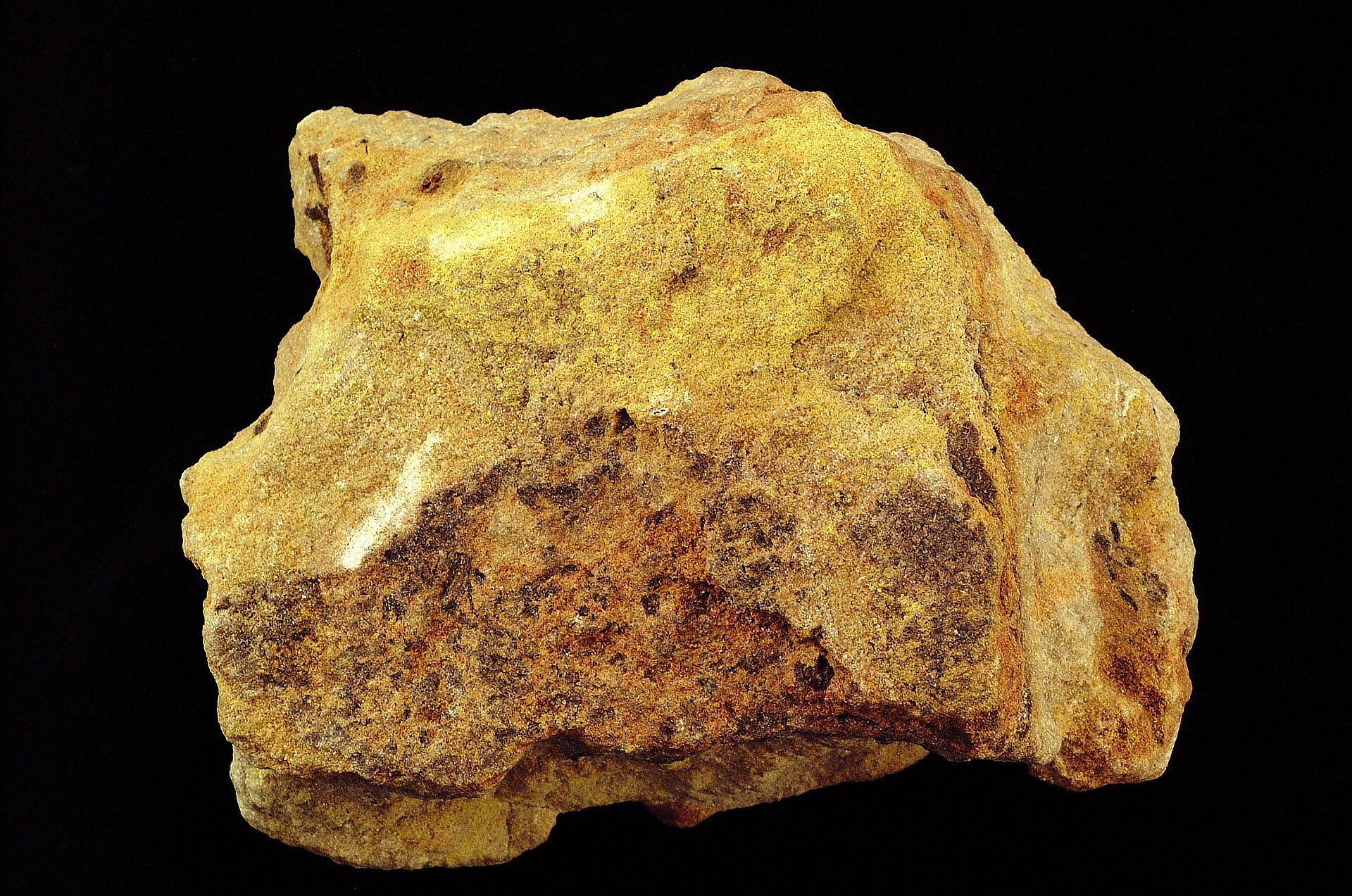
Carnotite, K2(UO2)2(VO4)2-(H2O)1-3 is a radioactive mineral and an ore of uranium and vanadium. It typically forms as aggregates of sand sized yellow grains; le — Photo: Darla Sondrol · CC0
Carnotite
Also known as: Uranium-vanadium ore.
A potassium uranyl vanadate — the classic yellow uranium ore of the Colorado Plateau.
Intro adapted from Wikipedia (CC BY-SA).
Carnotite is an IMA-recognized mineral species in the vanadate class, with the chemical formula K₂(UO₂)₂(VO₄)₂·3H₂O.
It crystallizes in the monoclinic crystal system (space group P2_1/c).
Key properties: Mohs hardness 2; specific gravity 4.7; typically yellow; Strontian-yellow streak; Dull, earthy; silky when crystalline luster; refractive index 1.919; optically biaxial.
IMA symbol Cnt, grandfathered status — known before the IMA’s founding, named in 1899.
An important ore mineral of uranium, typically in paleochannels in sandstone Colorado Plateau-type U–V deposits, found near fossil carbonaceous matter, and in calcretes and near playas; an alteration product of uraninite, montroseite.
It is found associated with Tyuyamunite, metatyuyamunite, volborthite, tangeite, metatorbernite, rossite, hewettite, other U–V oxides, gypsum, barite.
The mineral was named to honor Marie-Adolphe Carnot (1839–1920), French mining engineer and chemist.
Collections: Metals & Native Elements, Rare & Remarkable.