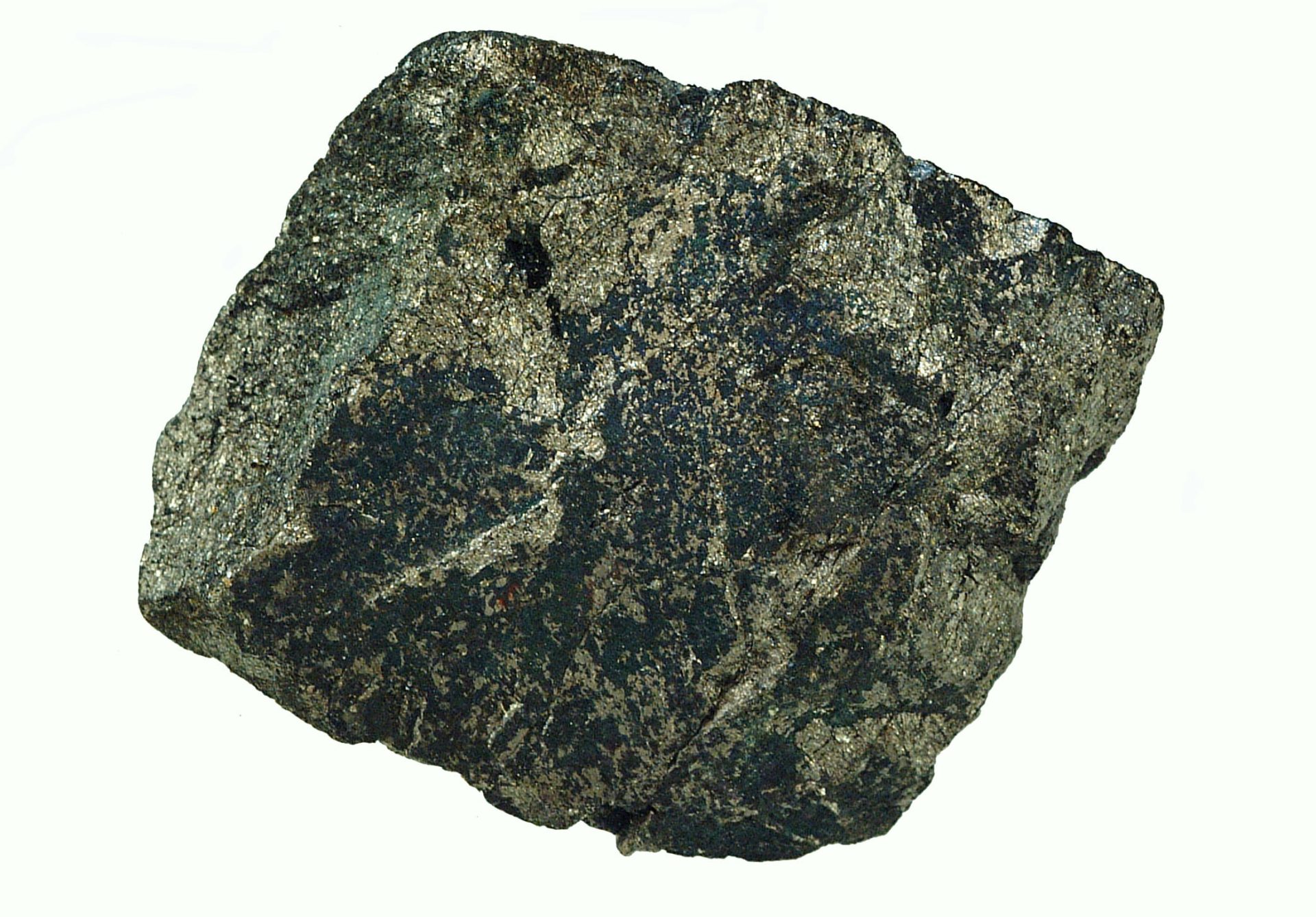
This specimen, 1.8 cm across, is almost all carrollite, Cu(Co,Ni)2S4, an obscure gray metallic sulfide mineral containing copper, cobalt and nickel, that forms in hydrothermal deposits. It is closely related to a number of equally rare sulfides and selenides that belong to the linnaeite group. — Photo: Nessa Eull · CC0
Carrollite
A copper-cobalt sulfide of the linnaeite group, often with nickel substituting, named for its type locality in Carroll County, Maryland.
Intro adapted from Wikipedia (CC BY-SA).
Carrollite is an IMA-recognized mineral species in the sulfide class, with the chemical formula CuCo₂S₄.
It crystallizes in the cubic crystal system (space group Fd3m). It is a member of the Spinel structural group.
Key properties: Mohs hardness 4.5–5.5; specific gravity 4.5–4.8; Metallic. R: (400) 41.4, (420) 41.5, (440) 41.6, (460) 41.8, (480) 42.0, (500) 42.3, (520) 42.6, (540) 42.9 luster.
IMA symbol Cli, grandfathered status — known before the IMA’s founding, named in 1852.
Found in hydrothermal vein deposits.
It is found associated with Tetrahedrite, linnaeite, siegenite, polydymite, chalcopyrite, bornite, digenite, djurleite, chacocite, pyrrhotite, pyrite, sphalerite, millerite, gersdorffite.
The name refers to its occurrence in Carroll Co., Maryland, USA. All rights reserved. No part of this publication may be reproduced.