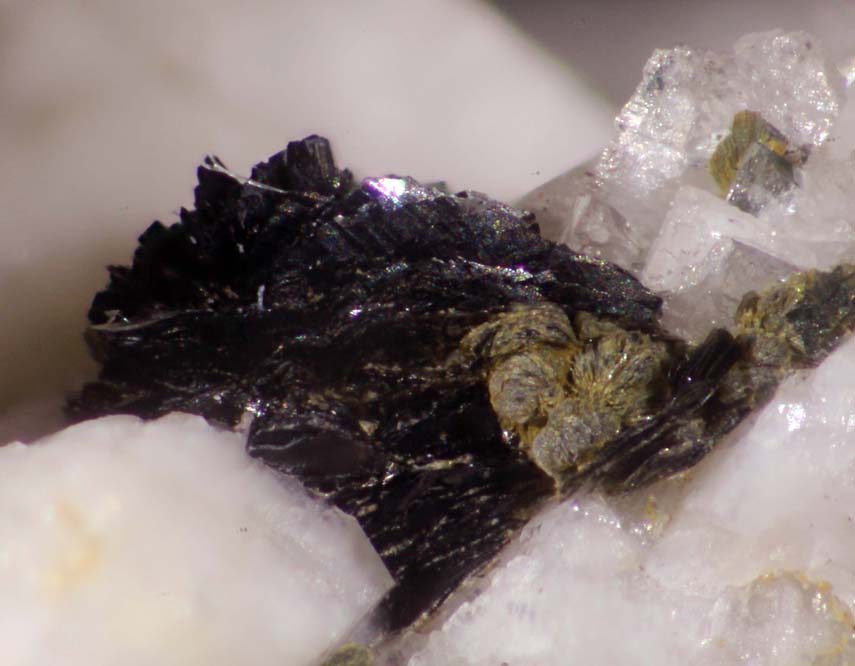
Cervandonite is a classic and very sought after mineral from Binntal. This specimen has a wonderful black cervandonite rossette. The mineral has only been found in two very close localities in the Alps (Binntal and Cervandone, which are geologically analogous), so it is almost a one locality mineral. From: Wanni Glacier, Binn Valley, Wallis, Switzerland. — Photo: David Hospital · CC BY-SA 4.0
Cervandonite-(Ce)
Cervandonite-(Ce) is an IMA-recognized mineral species in the silicate class, with the chemical formula (Ce,Nd,La)(Fe³⁺,Ti,Fe²⁺,Al)₃O₂(Si₂O₇)₁₋ₓ₊ᵧ(AsO₃)₁₊ₓ₋ᵧ(OH)₃ₓ₋₃ᵧ.
It crystallizes in the hexagonal crystal system (space group R3m).
Key properties: Mohs hardness 5; specific gravity 4.9; Brownish black streak; Adamantine luster; optically biaxial.
IMA symbol Cvd-Ce, IMA status: approved, named in 1986.
Found in narrow fissure-veins cutting two-mica gneiss.
It is found associated with Senaite, chernovite, rutile, anatase, muscovite, albite, chlorite, tourmaline, magnetite, hematite, quartz, synchysite.
The name commemorates the locality on the border between Italy and Switzerland where the mineral was discovered, Pizzo Cervandone.