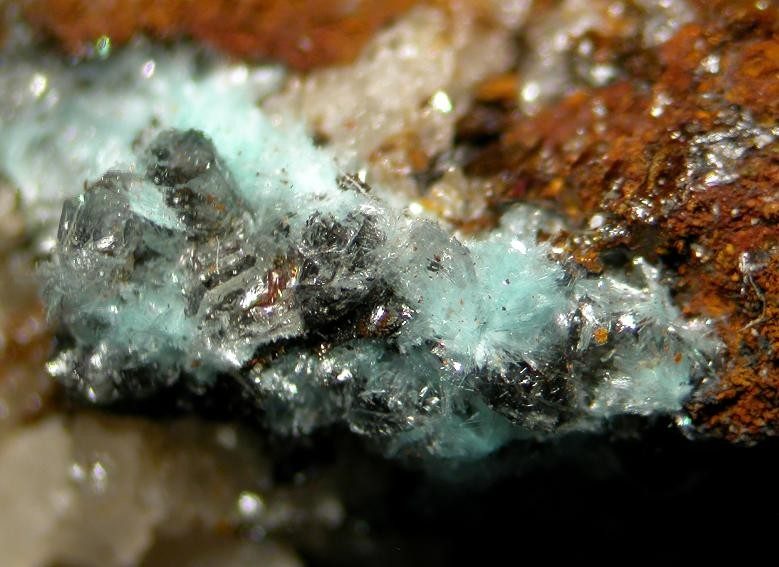
Chalconatronite Locality: Bastenberg Mine, Ramsbeck , Meschede , Sauerland , North Rhine-Westphalia , Germany ( Locality at mindat.org ) Light blue transparent crystals of Chalconatronite. Collected in 1986. Field of view 4 mm. Specimen and photo Leon Hupperichs. — Photo: Leon Hupperichs · CC BY-SA 3.0
Chalconatronite
A rare secondary copper-sodium carbonate — water-soluble when cold and notable for forming on ancient bronze artifacts.
Intro adapted from Wikipedia (CC BY-SA).
Chalconatronite is an IMA-recognized mineral species in the carbonate class, with the chemical formula Na₂Cu(CO₃)₂·3H₂O.
It crystallizes in the monoclinic crystal system (space group P2_1/n).
Key properties: Mohs hardness 1.5; specific gravity 2.27; optically biaxial.
IMA symbol Chna, grandfathered status — known before the IMA’s founding, named in 1955.
A component of patina on bronze artifacts, apparently characteristic of arid weathering environments (Egypt); an uncommon secondary mineral in the oxidation zone of polymetallic deposits.
It is found associated with Cuprite, atacamite (patina on bronze artifact); paratacamite, gypsum, brochantite, malachite, azurite, epsomite, nickeloan magnesite, glaukosphaerite.
Its name comes from the Greek chalcos, for copper, and natron, the modern name for naturally occurring sodium carbonate.