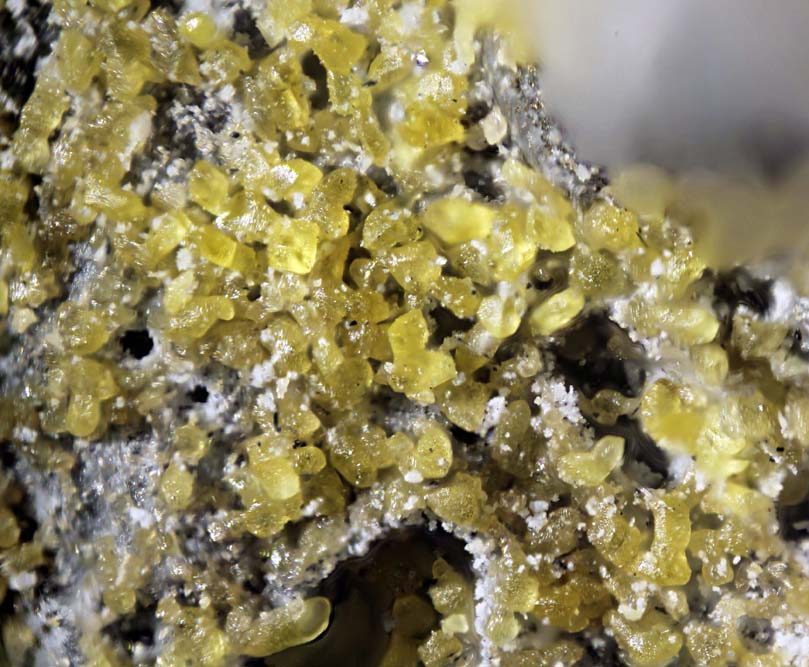
Honey yellow challacolloite crystals from the famous locality of La Fossa Crater (Vulcano Island, Aeolian Islands, Sicily, Italy). Very nice under the microscope for the contrast with the matrix. — Photo: David Hospital · CC BY-SA 4.0
Challacolloite
A rare potassium-lead chloride occurring as white fumarole encrustations on lava, intergrown with cotunnite.
Intro adapted from Wikipedia (CC BY-SA).
Challacolloite is an IMA-recognized mineral species in the halide class, with the chemical formula KPb₂Cl₅.
It crystallizes in the monoclinic crystal system (space group P2_1/c).
Key properties: Mohs hardness 2–3; specific gravity 4.77; White streak; Adamantine to greasy (on exposure to air) luster; optically biaxial.
IMA symbol Chc, IMA status: approved, named in 2004.
A hydrothermal mineral in an epithermal vein-type silver deposit (Chile). Also as a sublimate near volcanic fumaroles (Italy).
It is found associated with Cotunnite, boleite, pseudoboleite, hemimorphite, caracoite, anglesite, nitratine, anhydrite, fluorite.
The name refers to the Challacollo mine, where the specimens for description of the species were collected.