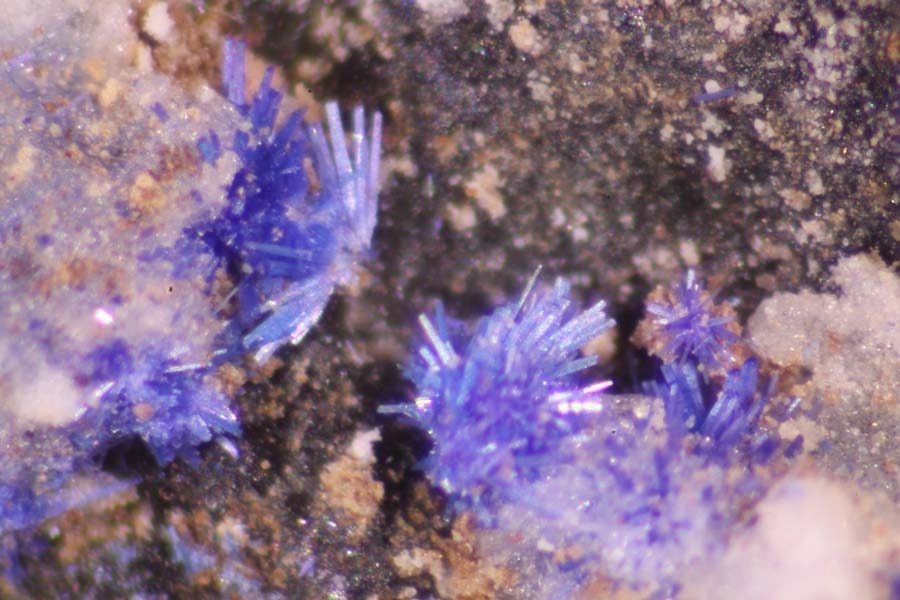
Deep purple rosettes of the new mineral chanabayaite recently described in Chile (IMA 2013-065). The mineral is a chemical oddity because is a mixture of an organic compoud (ammine-triazolate) and an inorganic compound (copper chlorine). It is only the second organometallic mineral in Nature (after ammineite). Only one locality known worldwide: Pabellon de Pica, Chanabaya, Iquique Province, Tarapacá Region, Chile. — Photo: David Hospital · CC BY-SA 4.0
Chanabayaite
The first mineral built around triazolate anions — a copper-nitrogen compound discovered in Chile, and one of the few minerals containing ammine groups.
Intro adapted from Wikipedia (CC BY-SA).
Chanabayaite is an IMA-recognized mineral species in the organic mineral class, with the chemical formula Cu₂Cl(N₃C₂H₂)₂(NH₃,Cl,H₂O, )₄.
It crystallizes in the orthorhombic crystal system (space group Imma).
Key properties: Mohs hardness 2; specific gravity 1.48; Blue streak; Vitreous luster; optically biaxial.
IMA symbol Cba, IMA status: approved, named in 2013.
Found in a guano deposit.
It is found associated with Sal ammoniac, halite, joanneumite, nitratine.
The name refers to the village of Chanabaya near the locality that produced the first specimens.