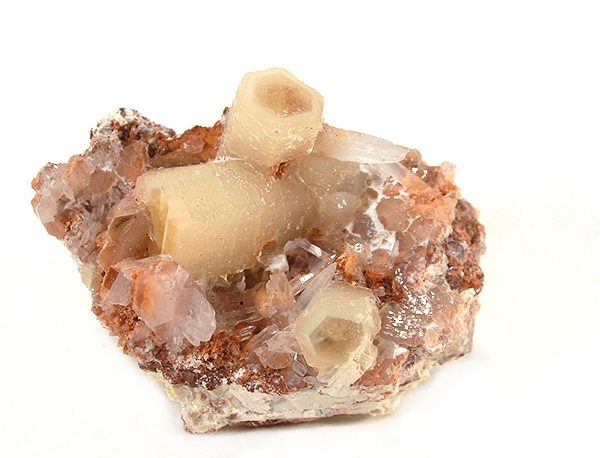
Calcite , Charlesite , Sturmanite Locality: N'Chwaning I Mine, N'Chwaning Mines, Kuruman , Kalahari manganese fields, Northern Cape Province , South Africa ( Locality at mindat.org ) Size: miniature, 4.4 x 2.9 x 1.7 cm Charlesite and Sturmanite with Calcite A very interesting specimen of charlesite cores surrounded by sturmanite (they are a series, and portions of the crystal are of different species, thus). These crystals are unusually well-formed to be so rich in charlesite, of which they mostly are composed. Charlesite is more white and lighter yellow, while the sturmanite is darker in hue as a general rule. — Photo: Robert M. Lavinsky · CC BY-SA 3.0
Charlesite
A sulfate mineral of the ettringite group, named in 1945 for Harvard mineralogist Charles Palache.
Intro adapted from Wikipedia (CC BY-SA).
Charlesite is an IMA-recognized mineral species in the sulfate class, with the chemical formula Ca₆Al₂(SO₄)₂B(OH)₄(OH,O)₁₂·26H₂O.
It crystallizes in the hexagonal crystal system (space group P31c). It is a member of the Ettringite structural group.
Key properties: Mohs hardness 2.5; specific gravity 1.77; White streak; Vitreous to dull luster; optically uniaxial.
IMA symbol Chrl, IMA status: approved, named in 1981.
Very rare, coating fractures and vugs in a metamorphosed stratiform zinc deposit.
It is found associated with Clinohedrite, ganophyllite, xonotlite, pectolite, prehnite, “Mn-chlorite”, roeblingite, willemite, datolite.
The mineral was named to honor Dr. Charles Palache (1869–1954), eminent American crystallographer and mineralogist, Harvard University, Cambridge, Massachusetts, USA.