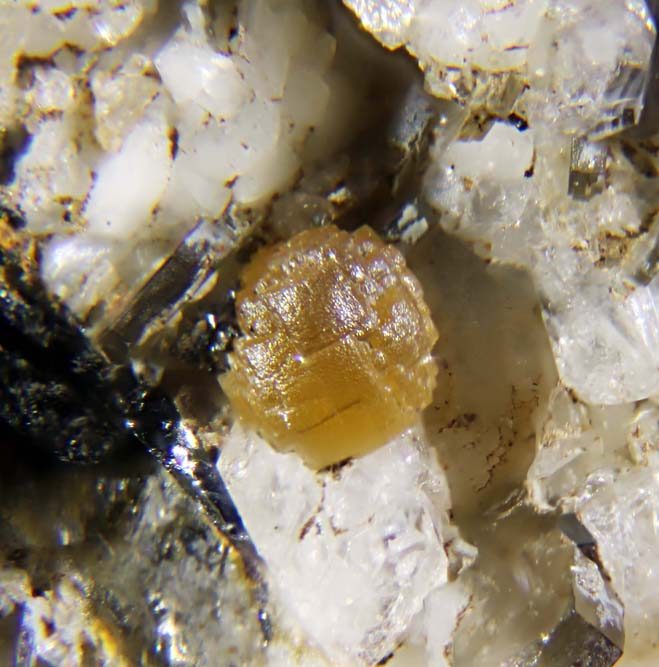
Brown isolated crystal of the rare yttrium mineral chernovite-(Y) from the famous locality of Monte Cervandone (italian name) or Cherbadung (Swiss german name), Devero Alp, Baceno, Devero Valley, Verbano-Cusio-Ossola Province, Piedmont, Italy. — Photo: David Hospital · CC BY-SA 4.0
Chernovite-(Y)
Chernovite-(Y) is a mineral. It was first described in 1967 as Chernovite, named after the Russian geologist Aleksandr A. Chernov. The suffix -(Y) was added in 1987. It is a colourless to pale yellow mineral with a vitreous luster. It has a tetragonal crystalline structure, and has the chemical makeup of Y(AsO4), which is yttrium, arsenic, and oxygen, at a 1:1:4 ratio. It has a specific gravity of 4.866g/cm3. Chernovite-(Y) is part of the Xenotime group.
Intro adapted from Wikipedia (CC BY-SA).
Chernovite-(Y) is an IMA-recognized mineral species in the arsenate class, with the chemical formula Y(AsO₄).
It crystallizes in the tetragonal crystal system (space group I4_1/amd). It is a member of the Zircon structural group.
Key properties: Mohs hardness 4.5; specific gravity 4.866; Vitreous luster; optically uniaxial.
IMA symbol Chv-Y, IMA status: approved, named in 1967.
Found in piemontite veinlets in liparite porphyry (Nyarta-Syu-Yu River, Russia); in Alpine-type fissures (Binntal, Switzerland).
It is found associated with Piemontite, molybdenian scheelite, albite, calcite, garnet, hastingsite, pyrolusite, hematite (Nyarta-Syu-Yu River, Russia); niobian rutile, magnetite.
The mineral was named to honor Professor Aleksandr Aleksandrovich Chernov (1877–1963), Russian geologist, Institute of Geology, Syktyvar, Russia, explorer of the Polar Urals.