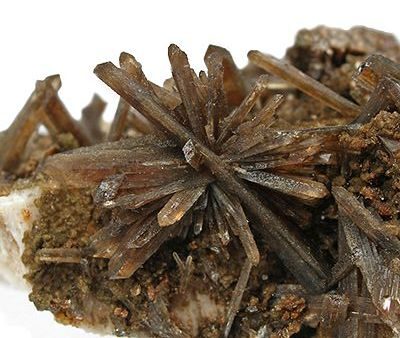
Childrenite Locality: Poço d'Antas claim, Piauí Valley, Taquaral , Itinga , Jequitinhonha valley, Minas Gerais , Southeast Region, Brazil ( Locality at mindat.org ) Size: small cabinet, 7.5 x 6.0 x 3.6 cm Childrenite (2 habits!) This matrix specimen has a lot going for it. There are a few super lustrous, almost metallic looking, botryoids, which are the terminal ends of many convergent childrenite crystals. In addition, there are free-standing childrenite crystals and at the very front of the specimen, therefore the best viewing angle, is this exquisite, rosette of bladed, lustrous, translucent, orangy-brown, childrenite crystals. The rosette measures 3.0 cm across. Outstanding! — Photo: Robert M. Lavinsky · CC BY-SA 3.0
Childrenite
A rare hydrated iron-manganese-aluminium phosphate found in granite pegmatites and hydrothermal veins.
Intro adapted from Wikipedia (CC BY-SA).
Childrenite is an IMA-recognized mineral species in the phosphate class, with the chemical formula Fe²⁺Al(PO₄)(OH)₂·H₂O.
It crystallizes in the orthorhombic crystal system (space group Bba2). It is a member of the Childrenite structural group.
Key properties: Mohs hardness 5; specific gravity 3.11–3.19; White streak; Vitreous to resinous luster; optically biaxial.
IMA symbol Chd, grandfathered status — known before the IMA’s founding, named in 1823.
Found in some complex granite pegmatites, typically a low-temperature hydrothermal alteration product of primary phosphate minerals.
It is found associated with Siderite, pyrite, apatite, quartz (Tavistock, England); zinnwaldite, tourmaline, apatite, kaolinite (Greifensteine, Germany).
In honor of John George Children (1777–1852), English chemist and mineralogist.