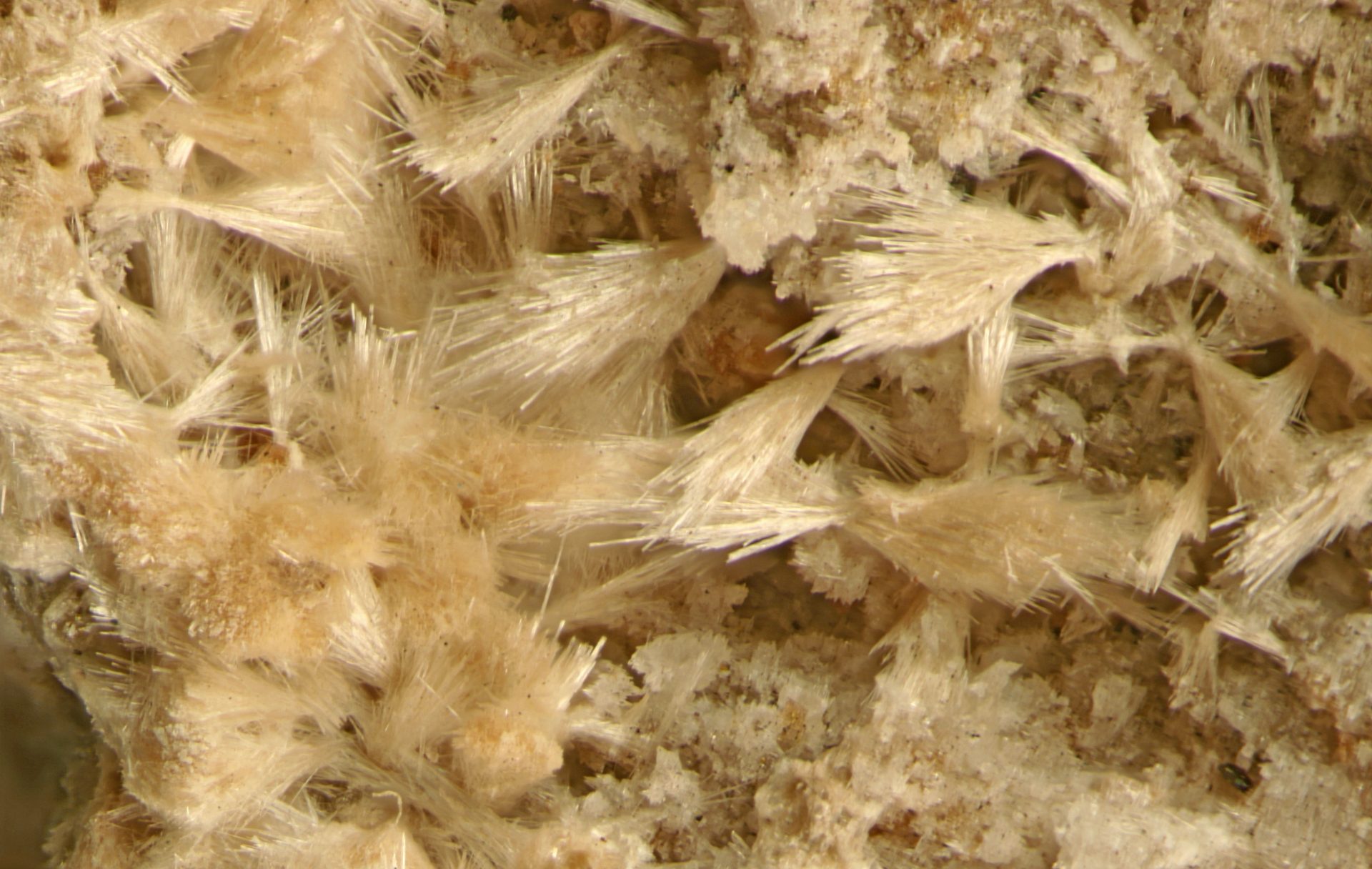
FOV 7.1 x 4.4 mm. Ex D. Phister via Franklin Mineral Museum. MOB coll. This is a very rich specimen (roughly 2 x 6 cm) almost entirely covered with chlorophoenicite and sprinkled with tiny hodgkinsonite (?) xls. The color is not white - rather it is pale mousy brownish. In fact, the specimen looks a bit like a dead mouse from a distance! Updated Nov 2012 with a full res image. From: Sterling Mine, Sterling Hill, Ogdensburg, Franklin Mining District, Sussex Co., New Jersey, USA. — Photo: Modris Baum · CC0
Chlorophoenicite
Chlorophoenicite is an IMA-recognized mineral species in the arsenate class, with the chemical formula (Mn,Mg,Zn)₃Zn₂(AsO₄)(OH,O)₆.
It crystallizes in the monoclinic crystal system (space group C2/m). It is a member of the Chlorophoenicite structural group.
Key properties: Mohs hardness 3.5; specific gravity 3.46–3.53; Vitreous, silky, pearly on cleavages luster; optically biaxial.
IMA symbol Cpo, grandfathered status — known before the IMA’s founding, named in 1924.
Along secondary cracks through franklinite ores in a metamorphosed stratiform zinc orebody.
It is found associated with Leucophoenicite, hodgkinsonite, hetaerolite, tephroite, gageite, chlorophoenicite, sclarite, pyrochroite, willemite, zincite, calcite, barite, franklinite.
Its name comes from the Greek for green and purple-red, alluding to the mineral’s colors in natural and artificial light.