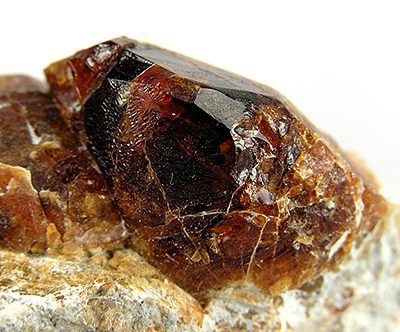
Chondrodite Locality: Tilly Foster mine, Brewster , Putnam County, New York , USA ( Locality at mindat.org ) Size: miniature, 4.3 x 3.3 x 2.4 cm Chondrodite A very showy, large specimen of chondrodite from the famous old Tilly Foster Mine, active in the early 1900s and as far back as 1880-something. This piece features large crystals to an inch with unusualy vivid, deep color. It is as fine a miniature as you can ask for, and very hard to find in quality — Photo: Robert M. Lavinsky · CC BY-SA 3.0
Chondrodite
The most common member of the humite group — a magnesium-iron nesosilicate found in metamorphosed limestones and skarns.
Intro adapted from Wikipedia (CC BY-SA).
Chondrodite is an IMA-recognized mineral species in the silicate class, with the chemical formula Mg₅(SiO₄)₂F₂.
It crystallizes in the monoclinic crystal system (space group P2_1/b). It is a member of the Humite structural group.
Key properties: Mohs hardness 6–6.5; specific gravity 3.16–3.26; Vitreous to resinous luster; refractive index 1.631; optically biaxial.
IMA symbol Chn, grandfathered status — known before the IMA’s founding, named in 1817.
Found in contact metamorphic zones, in limestones and dolostones, in association with felsic to alkalic plutonic rocks, especially with Fe-B-F metasomatism; in a carbonatite.
It is found associated with Phlogopite, spinel, magnetite, grossular, wollastonite, forsterite, monticellite, cuspidine, diopside, calcite.
Its name comes from the Greek meaning grain, alluding to its occurrence in isolated grains.