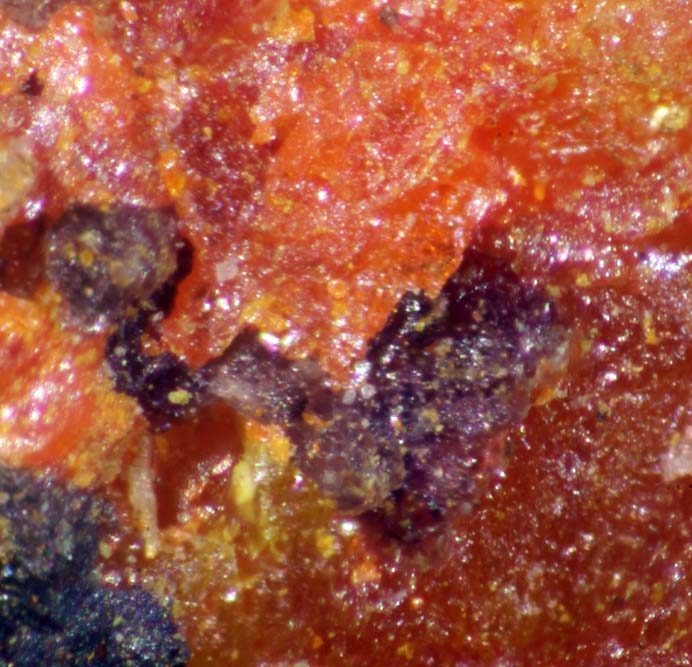
Dark red christite crystal, a very rare thallium mineral, in a matrix of orpiment and realgar from a new find in Shimen, China (Jiepaiyu, Shimen County, Hunan Province), a locality that was only previously known for orpiment and realgar crystals. Specimen analyzed by SEM. — Photo: David Hospital · CC BY-SA 4.0
Christite
A crimson to bright-orange thallium-mercury-arsenic sulfide named for USGS member Charles L. Christ.
Intro adapted from Wikipedia (CC BY-SA).
Christite is an IMA-recognized mineral species in the sulfosalt class, with the chemical formula TlHgAsS₃.
It crystallizes in the monoclinic crystal system (space group P2_1/n).
Key properties: Mohs hardness 1–2; specific gravity 6.15; Bright orange, yellow streak; Adamantine luster; optically biaxial.
IMA symbol Cri, IMA status: approved, named in 1976.
Found in hydrothermal barite veins and in mineralized carbonaceous silty dolostone (Carlin mine, Nevada, USA); in thallium-rich pods in a stratabound mercury deposit (Lanmuchang deposit, China).
It is found associated with Realgar, orpiment, lorandite, barite, getchellite (Carlin mine, Nevada, USA); lorandite, barite, marcasite, pyrite (Lanmuchang deposit, China).
The mineral was named to honor Dr. Charles Louis Christ (1916–1980), American physical chemist, mineralogist, and crystallographer with the U.S. Geological Survey.