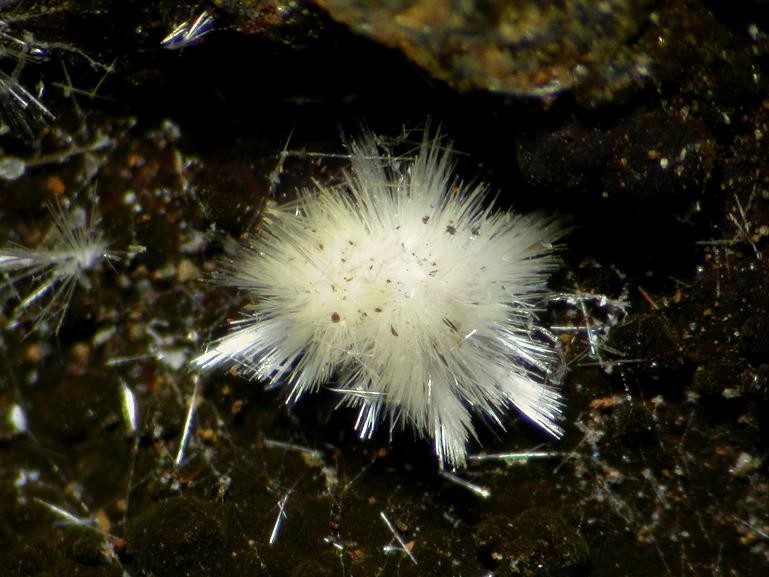
Churchite-(Y) Locality: Leonie I Mine (Leonie Mine; Alte Leonie Mine), Auerbach, Upper Palatinate, Bavaria, Germany Field of view 3 mm. Specimen and photo Leon Hupperichs. — Photo: Leon Hupperichs · CC BY-SA 3.0
Churchite-(Y)
Churchite-(Y) is an IMA-recognized mineral species in the phosphate class, with the chemical formula Y(PO₄)·2H₂O.
It crystallizes in the monoclinic crystal system (space group I2/a). It is a member of the Gypsum structural group.
Key properties: Mohs hardness 3; specific gravity 3.26; Vitreous, pearly on cleavages luster; optically biaxial.
IMA symbol Cuh-Y, IMA status: approved, named in 1865.
Locally abundant; typically derived from meteoric waters, with yttrium weathered or biochemically leached from trace amounts in surrounding rocks or soil, deposited on colloidal Fe–Mn oxides.
It is found associated with Florencite, rhabdophane, wavellite, crandallite, turquoise, variscite, cacoxenite, beraunite, dufrénite, goyazite, gorceixite, crandallite, monazite, apatite.
The mineral was named to honor Arthur Herbert Church (1834–1915), English chemist, who originally analyzed and described the mineral.