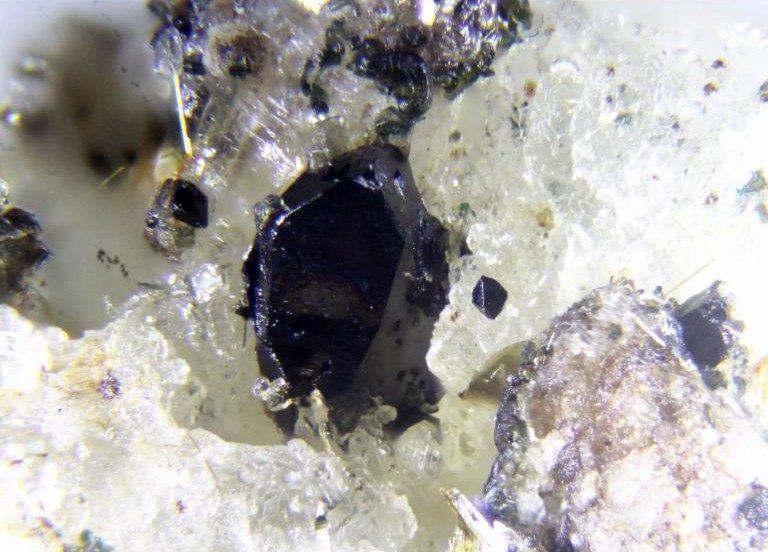
Black sharp crystal of the rare complex oxide mineral cleusonite from Switzerland (Fibbia, Fontana, Leventina, Ticino, Switzerland). Ex. Erich Laskowski collection (USA). — Photo: David Hospital · CC BY 4.0
Cleusonite
A complex lead-strontium-uranium titanate of the crichtonite group — a family of about thirteen metal titanates.
Intro adapted from Wikipedia (CC BY-SA).
Cleusonite is an IMA-recognized mineral species in the oxides & hydroxide class, with the chemical formula Pb(U⁴⁺,U⁶⁺)Fe²⁺₂(Ti,Fe²⁺,Fe³⁺)₁₈(O,OH)₃₈.
It crystallizes in the hexagonal crystal system (space group R-3). It is a member of the Crichtonite structural group.
Key properties: Mohs hardness 6–7; specific gravity 4.74; Black streak; Bright submetallic luster.
IMA symbol Ceu, IMA status: approved, named in 1998.
Found in alpine-type cleft veins in greenschist facies metamorphic rocks.
It is found associated with Clausthalite, chalcopyrite, uraninite, quartz, chlorite, calcite, albite, microcline, tourmaline, fluorapatite, zircon, ilmenite, hematite, titanite, pyrite.
The name is derived from the locality, Cleuson, Switzerland, that provided the specimens for complete description of the species.