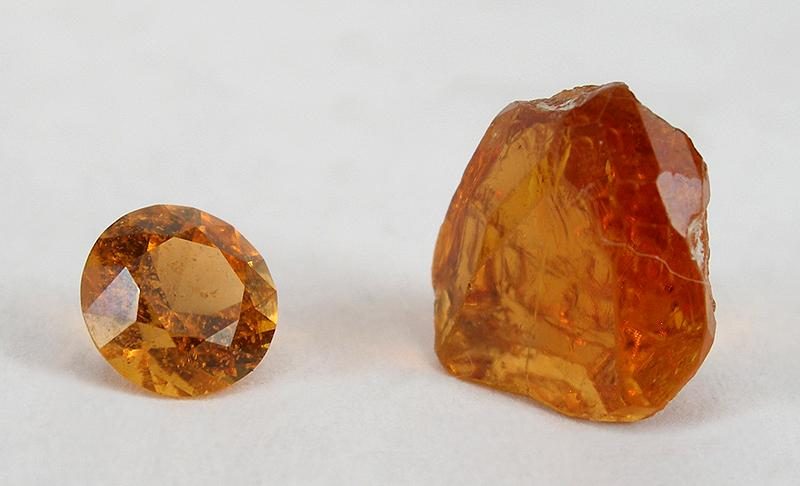
Clinohumite Locality: Gem spinel deposit, Kukh-i-Lal (Kukhilal; Kuhi-lal), Pyandzh River Valley, Pamir Mts, Viloyati Mukhtori Gorno-Badakhshan (Viloyati Badakhshoni Kuni), Tajikistan ( Locality at mindat.org ) Size: thumbnail, 1.0 x 0.9 x 0.6 cm (specimen) and 5 x 5 Clinohumite cut and rough set Stunning crystal, of total gem quality, and a relatively large cut stone cut from this unusual and fiery orange clinohumite that is widely considered to be the worlds best of species. This crystal actually is pretty good on its own complete on top termination and just a nick in the bottom-left. It is very gemmy and bright, just like the matching gem!. — Photo: Robert M. Lavinsky · CC BY-SA 3.0
Clinohumite
An uncommon humite-group magnesium silicate whose formula reads as four olivine units plus one brucite.
Intro adapted from Wikipedia (CC BY-SA).
Clinohumite is an IMA-recognized mineral species in the silicate class, with the chemical formula Mg₉(SiO₄)₄F₂.
It crystallizes in the monoclinic crystal system (space group P2_1/b). It is a member of the Humite structural group.
Key properties: Mohs hardness 6; specific gravity 3.17–3.35; Vitreous luster; refractive index 1.675; optically biaxial.
IMA symbol Chu, grandfathered status — known before the IMA’s founding, named in 1876.
Found in contact metamorphic zones in dolostones and metasomatized limestones adjacent to felsic plutonic rocks; in serpentine and talc schists; in a carbonatite.
It is found associated with Grossular, wollastonite, forsterite, monticellite, cuspidine, fluoborite, ludwigite, dolomite, calcite, talc, biotite, spinel, vesuvianite, sanidine, meionite.
The name refers to its monoclinic crystal system and relation to humite.