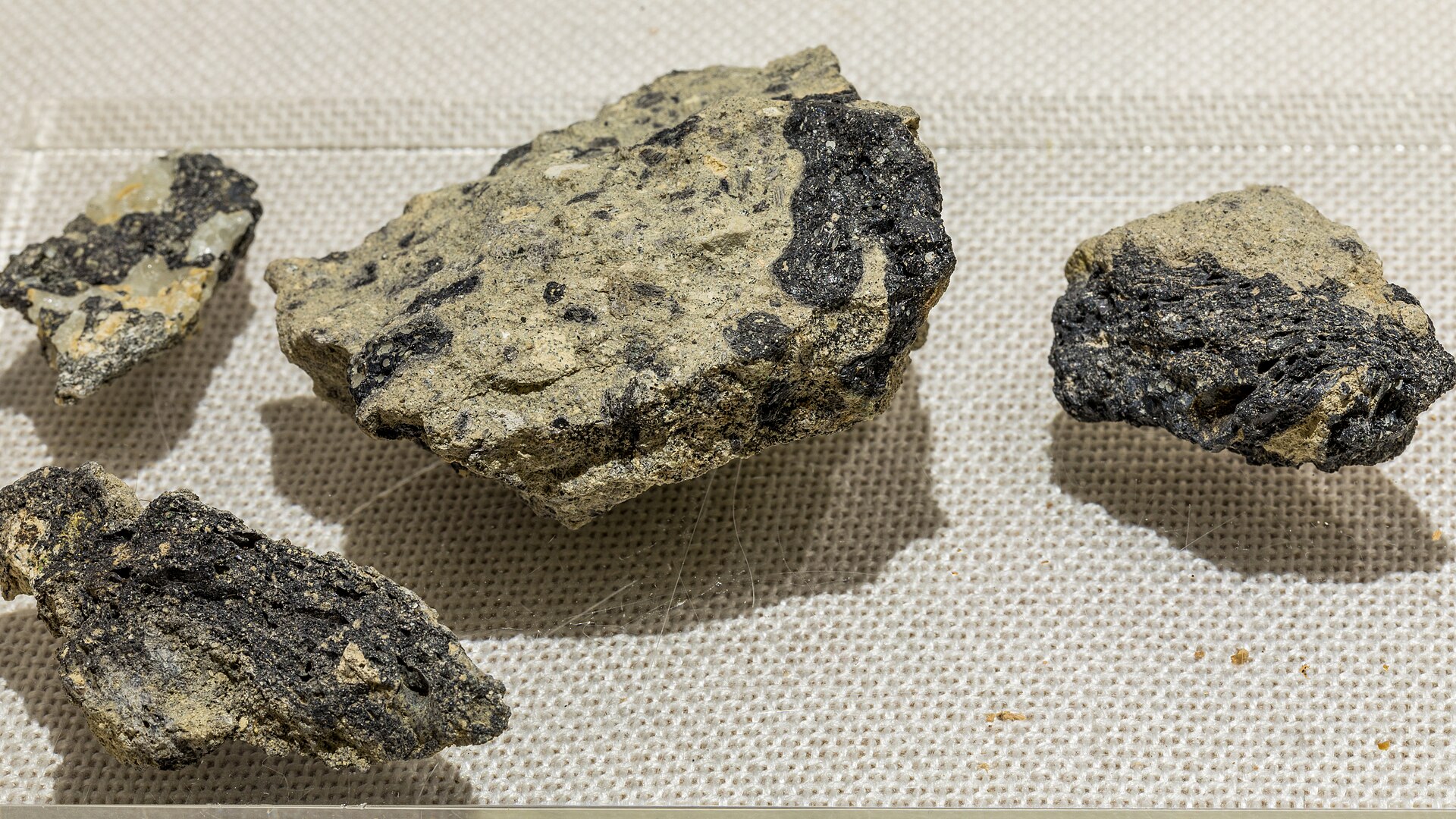
Suevite, glass, coesite - Place of discovery: Otting, Nördlinger Ries, Germany — Photo: Raimond Spekking · CC BY-SA 4.0
Coesite
A high-pressure polymorph of silica formed at 2–3 gigapascals — a diagnostic marker of meteorite impact craters and subducted crust.
Intro adapted from Wikipedia (CC BY-SA).
Coesite is an IMA-recognized mineral species in the silicate class, with the chemical formula SiO₂.
It crystallizes in the monoclinic crystal system (space group C2/c).
Key properties: Mohs hardness 7–8; specific gravity 2.92; typically colorless or white; white streak; Vitreous luster; refractive index 1.596; optically biaxial.
IMA symbol Coe, IMA status: approved, named in 1954.
Formed at pressures in excess of 20 kbar, as fine-grained intergrowths with quartz and silica glass in impact metamorphosed rocks and tektites. A primary phase in grospydite (kyanite-garnet-clinopyroxene) xenoliths in kimberlite.
It is found associated with Quartz, stishovite, silica glass, kyanite, omphacite, garnet, sanidine, muscovite, talc, rutile, dolomite.
The name refers to Loring Coes, Jr. (1915{), American chemist, who synthesized the material prior to the discovery of a natural occurrence.
Collections: Rare & Remarkable.