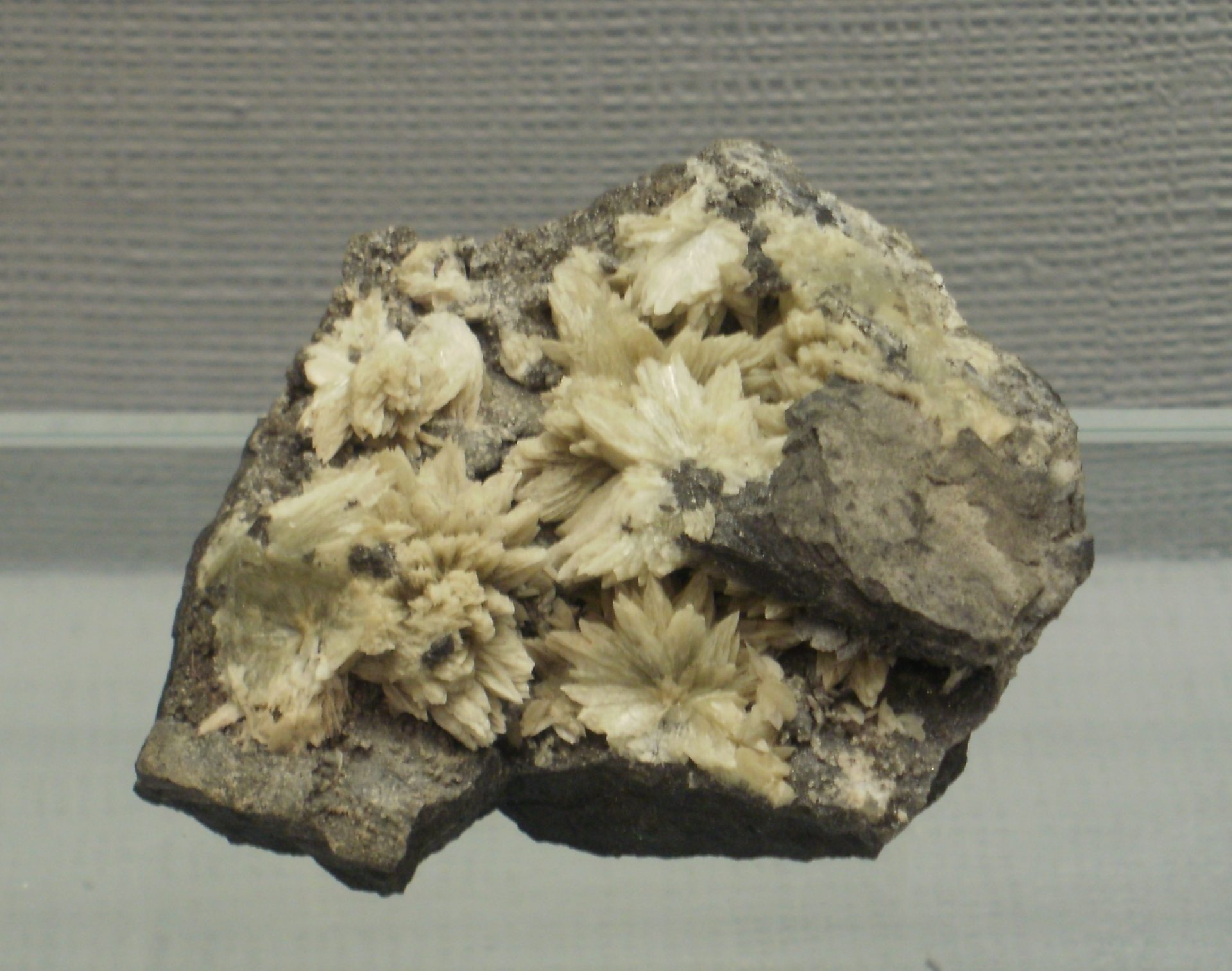
Collinsite from the Rapid Creek area of northern Yukon , Canada. Held in the A. E. Seaman Mineral Museum . — Photo: Chris857 · CC BY-SA 3.0
Collinsite
A hydrated calcium-magnesium phosphate discovered in British Columbia in 1927, named for Geological Survey of Canada director William Collins.
Intro adapted from Wikipedia (CC BY-SA).
Collinsite is an IMA-recognized mineral species in the phosphate class, with the chemical formula Ca₂Mg(PO₄)₂·2H₂O.
It crystallizes in the triclinic crystal system (space group P-1). It is a member of the Fairfieldite structural group.
Key properties: Mohs hardness 3.5–5; specific gravity 2.93–2.95; White streak; Subvitreous, silky if fibrous luster; refractive index 1.644; optically biaxial.
IMA symbol Coll, grandfathered status — known before the IMA’s founding, named in 1927.
A secondary weathering product typically incrusting other minerals.
It is found associated with Carbonatian fluorapatite, bitumen (Lake François, Canada); parahopeite, scholzite, cryptomelane, Fe–Mn oxides (Reaphook Hill, Australia); bobierrite.
The mineral was named to honor William Henry Collins (1878–1937), formerly Director of the Geological Survey of Canada.