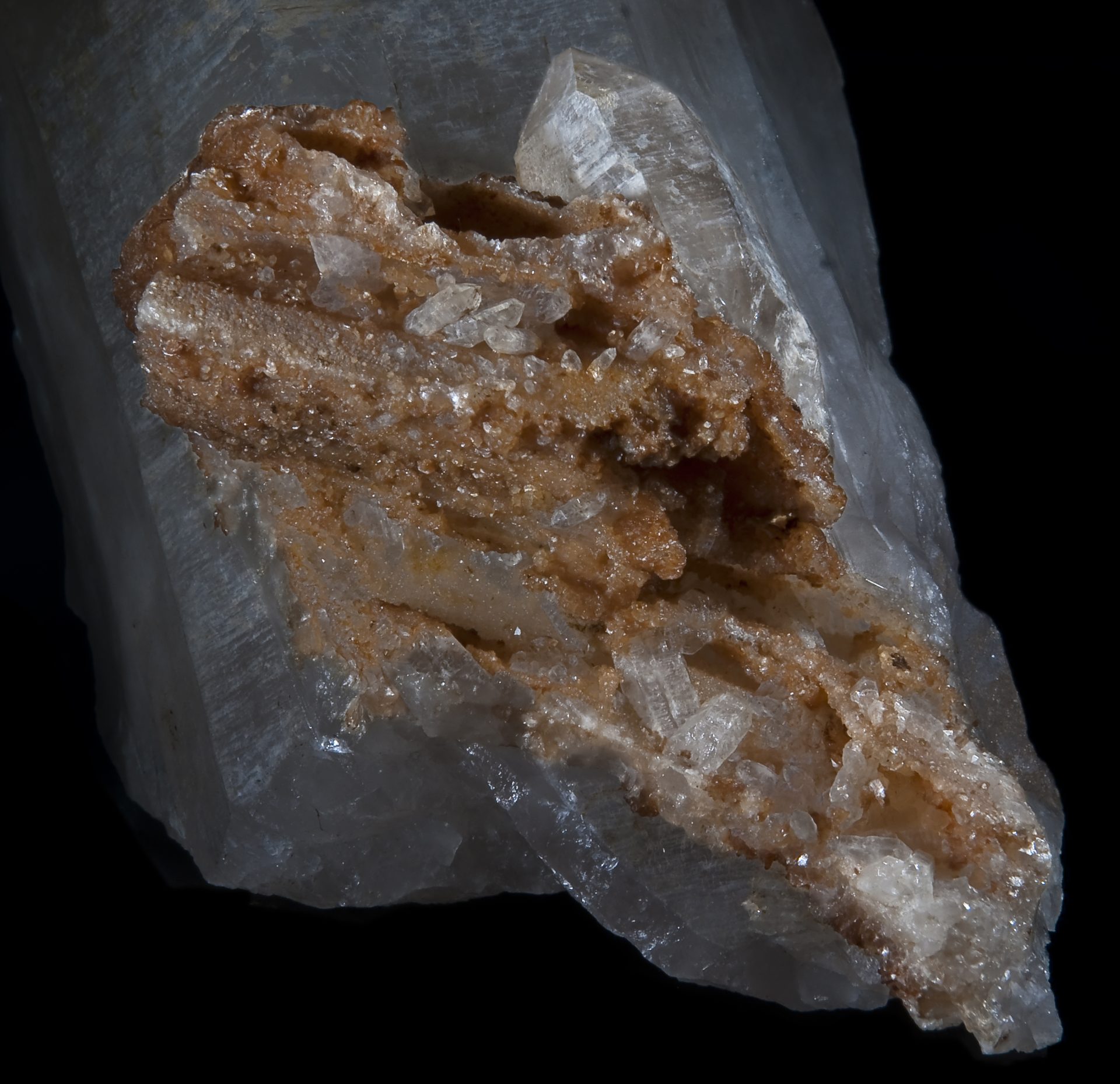
Cookeite on quartz Locality : Mt Mica Quarry, Paris, Oxford Co., Maine, USA - Deposite topotype - Coll. Emile Bertand (1844-1909) Size view 6cm — Photo: Didier Descouens · CC BY-SA 4.0
Cookeite
A soft lithium-aluminium chlorite — a pale phyllosilicate built of alternating layers, common in lithium-rich pegmatites.
Intro adapted from Wikipedia (CC BY-SA).
Cookeite is an IMA-recognized mineral species in the silicate class, with the chemical formula (Al,Li)₃Al₂(Si,Al)₄O₁₀(OH)₈.
It crystallizes in the monoclinic crystal system (space group Cc). It is a member of the Chlorite, Clay structural group.
Key properties: Mohs hardness 2.5–3.5; specific gravity 2.58–2.69; Pearly or silky luster; optically biaxial.
IMA symbol Ckt, grandfathered status — known before the IMA’s founding, named in 1866.
A late-stage hydrothermal alteration product of lithium-bearing minerals in pegmatites; a primary hydrothermal vein mineral.
It is found associated with Lepidolite, spodumene, tourmaline, petalite, quartz, albite, microcline.
The name refers to Josiah B. Cooke, Jr. (1827–1894), American mineralogist and chemist, Harvard University, Cambridge, Massachusetts, USA.