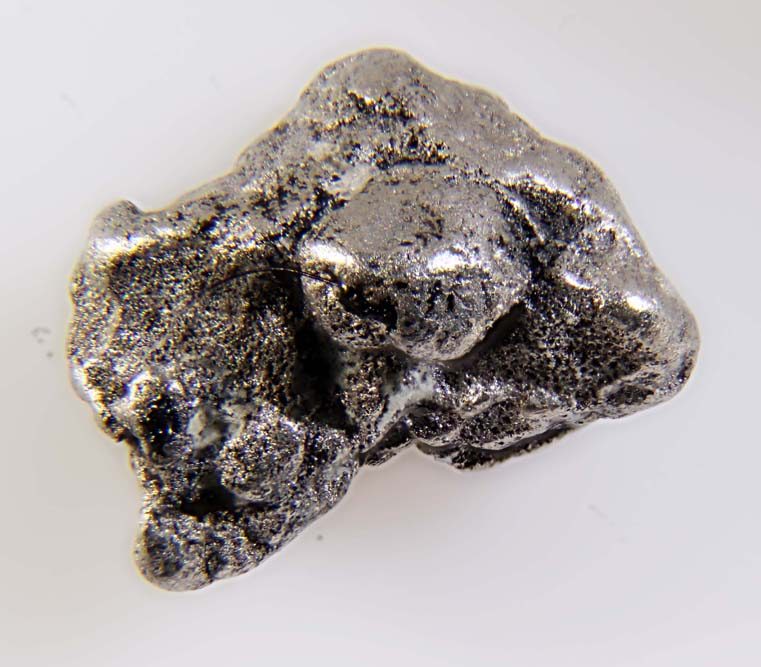
Outstanding specimen of the extremely rare platinum mineral cooperite (PtS). Analyzed specimen. Cooperite is very rarely seen on the mineral market, much less in specimens different from polished sections, like this one, that is a single nugget. From: Tulameen River, Princeton, British Columbia, Canada. — Photo: David Hospital · CC BY-SA 4.0
Cooperite
A rare platinum sulfide (PtS) — the tetragonal platinum ore mineral found in layered intrusions.
Intro adapted from Wikipedia (CC BY-SA).
Cooperite is an IMA-recognized mineral species in the sulfide class, with the chemical formula PtS.
It crystallizes in the tetragonal crystal system (space group P4_2/mmc).
Key properties: Mohs hardness 4–5; specific gravity 9.5; Metallic luster.
IMA symbol Cpe, grandfathered status — known before the IMA’s founding, named in 1928.
A significant platinum ore mineral, found in ultramafics, gabbros, dunites, chromitites, typically layered; in massive chalcopyrite–pyrrhotite orebodies; in alluvial placers.
It is found associated with Braggite, vysotskite, sperrylite, moncheite, platarsite, laurite, malanite, hollingsworthite, platinum, Pt–Fe alloys and many other PGM species, chalcopyrite.
The mineral was named to honor Richard A. Cooper (1890–1972), South African metallurgist, Johannesburg, South Africa, who first described the mineral.