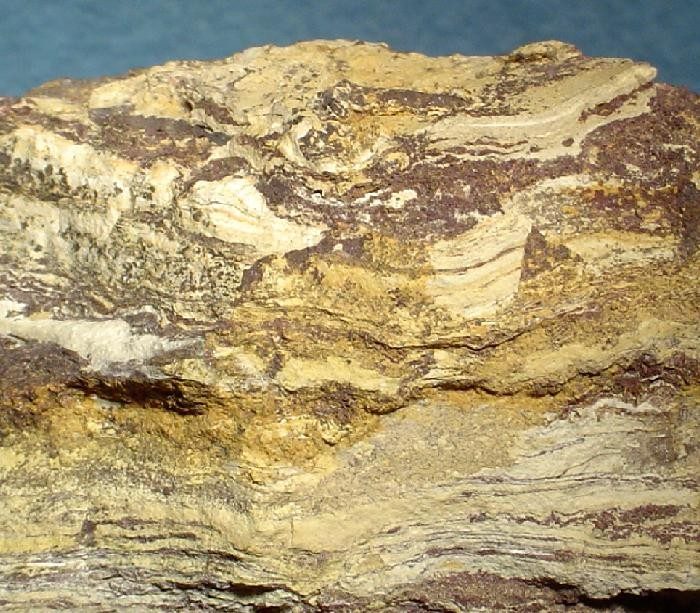
Corderoite , Cinnabar Locality: McDermitt Mine (Cordero Mine; Old Cordero Mine), Opalite District, Humboldt County, Nevada , USA ( Locality at mindat.org ) Size: 6.2 x 4.4 x 4.0 cm. Corderoite is a very rare mercury chloride sulfide and this excellent layered specimen is from the Type Locality - the McDermitt (Cordero) Mine of Nevada. This is very rich mercury ore. Dark red bands of microcrystalline to massive cinnabar alternate with layers of tan limonite. The corderoite is the rich dusting of the yellow-tan microcrystals found on all sides of the specimen and on both the cinnabar and limonite. Corderoite was not named until 1974, but primary mercury production of this small mine was over before 1941. This material probably dates to that time. From an old European collection. — Photo: Robert M. Lavinsky · CC BY-SA 3.0
Corderoite
An extremely rare mercury sulfide-chloride — soft, isometric, and ranging from light gray to black, pink or yellow.
Intro adapted from Wikipedia (CC BY-SA).
Corderoite is an IMA-recognized mineral species in the sulfide class, with the chemical formula Hg₃S₂Cl₂.
It crystallizes in the cubic crystal system (space group I2_13).
Key properties: Mohs hardness 3; specific gravity 6.74.
IMA symbol Cde, IMA status: approved, named in 1973.
Found in lake-bed sediments and underlying silicified rhyolite tuffs, possibly of low-temperature secondary origin (McDermitt mine, Nevada, USA); in an oxidized hydrothermal deposit (Arzak deposit, Russia).
It is found associated with Cinnabar, kleinite, kenhsuite, radtkeite, montmorillonite, quartz, cristobalite, orthoclase, plagioclase (McDermitt mine, Nevada, USA); cinnabar, calomel.
The name refers to its occurrence in the McDermitt (formerly Cordero) mine, USA.