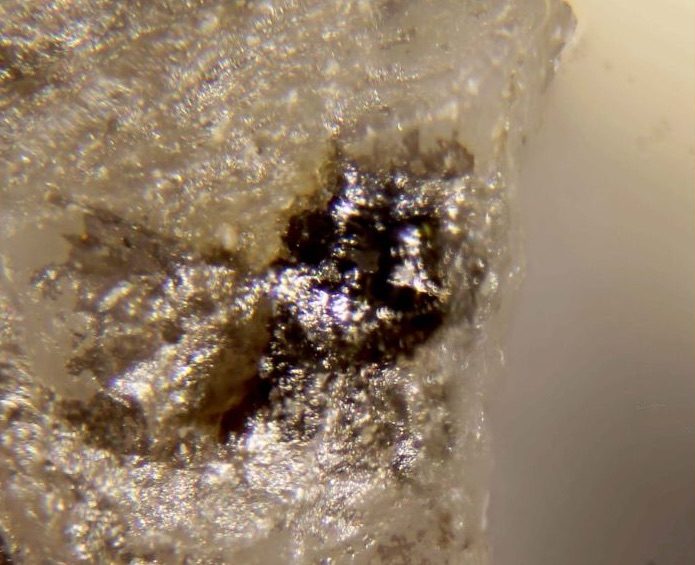
Silvery metallic crystals of the extremely rare Tl-Ag-Au mineral criddleite from the type locality in Hemlo mine, Ontario, Canada. Completely analyzed specimen by SEM/EDS. Ex Vandenbroucke Museum collection from Waregem, Belgium. — Photo: David Hospital · CC BY-SA 4.0
Criddleite
Criddleite is an IMA-recognized mineral species in the sulfosalt class, with the chemical formula Ag₂Au₃TlSb₁₀S₁₀.
It crystallizes in the monoclinic crystal system.
Key properties: Mohs hardness 3–3.5; specific gravity 6.86; Black streak; Metallic luster.
IMA symbol Cdd, IMA status: approved, named in 1987.
A primary hydrothermal mineral in a complex gold deposits.
It is found associated with Aurostibite, gold, antimony, chalcostibite, parapierrotite, stibnite, tetrahedrite, molybdenite, zinkenite, pyrite, quartz (Hemlo deposit, Canada); gold.
The mineral was named to honor Dr. Alan John Criddle (1944–2002), English mineralogist of the British Museum (Natural History), London, England.