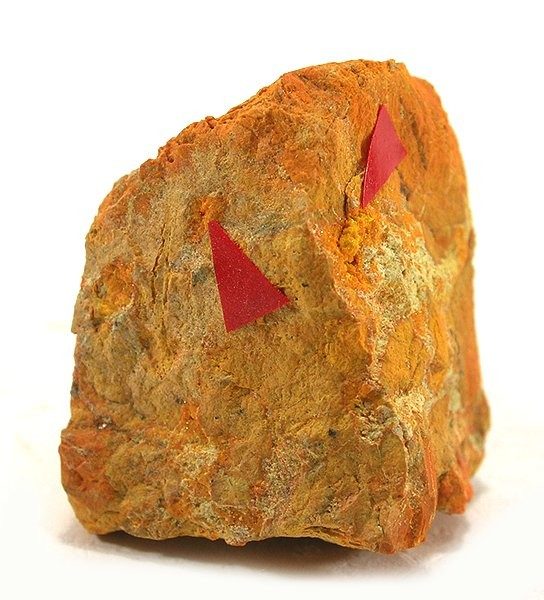
Schoepite , Curite Locality: Shinkolobwe Mine (Kasolo Mine), Shinkolobwe , Central area, Katanga Copper Crescent, Katanga (Shaba) , Democratic Republic of Congo (Zaïre) ( Locality at mindat.org ) curite microcrystals in massive schoepite. 2.6 x 2.6 x 2.2 cm — Photo: Robert M. Lavinsky · CC BY-SA 3.0
Curite
A rare hydrated lead-uranyl oxide forming orange-red needles — named for Marie and Pierre Curie.
Intro adapted from Wikipedia (CC BY-SA).
Curite is an IMA-recognized mineral species in the oxides & hydroxide class, with the chemical formula Pb₃₊ₓ[(UO₂)₄O₄₊ₓ(OH)₃₋ₓ]₂·2H₂O.
It crystallizes in the orthorhombic crystal system (space group Pnam).
Key properties: Mohs hardness 4–5; specific gravity 6.98–7.4; Orange streak; Adamantine luster; refractive index 2.107; optically biaxial.
IMA symbol Cui, grandfathered status — known before the IMA’s founding, named in 1921.
A secondary mineral commonly formed through alteration of uraninite.
It is found associated with Fourmarierite, vandendriesscheite, schoepite, soddyite, kasolite, dewindtite, torbernite, rutherfordine, sklodowskite.
The mineral was named to honor French physicist Pierre Curie (1856–1906), student of radioactivity.