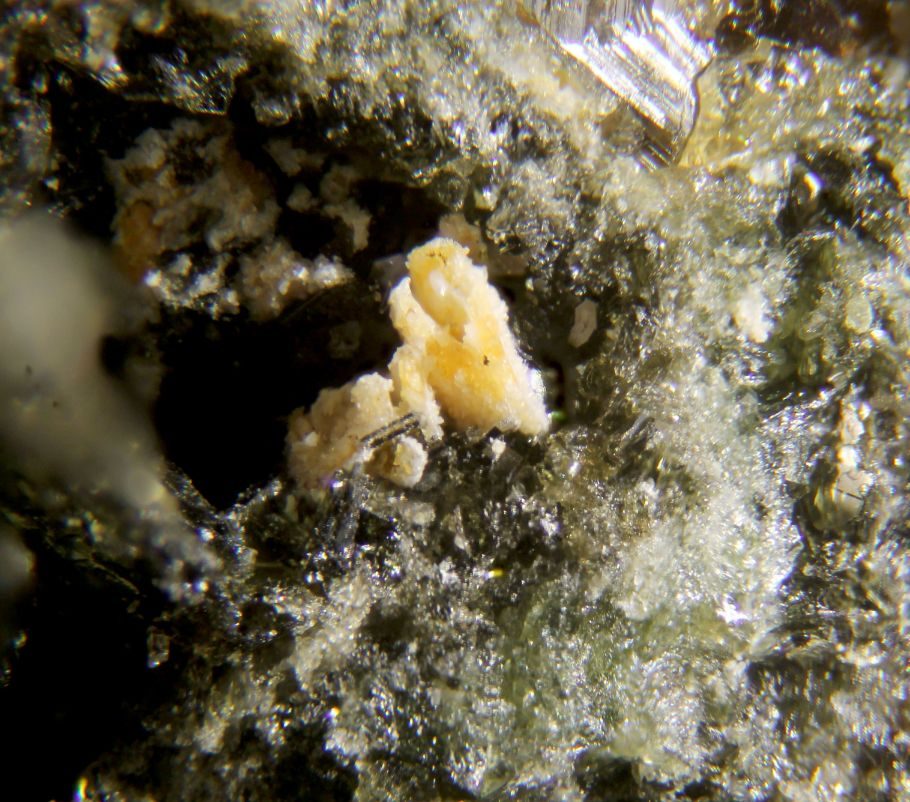
Outstanding yellowish cuspidine crystals from the type locality in Vesuvius: Monte Somma, Vesuvius, Campania, Italy. — Photo: David Hospital · CC BY-SA 4.0
Cuspidine
A fluorine-bearing calcium sorosilicate of the wöhlerite group, crystallizing in the monoclinic system.
Intro adapted from Wikipedia (CC BY-SA).
Cuspidine is an IMA-recognized mineral species in the silicate class, with the chemical formula Ca₈(Si₂O₇)₂F₄.
It crystallizes in the monoclinic crystal system (space group P2_1/c). It is a member of the Wöhlerite structural group.
Key properties: Mohs hardness 5–6; specific gravity 2.85–2.96; Vitreous luster; refractive index 1.595; optically biaxial.
IMA symbol Csp, grandfathered status — known before the IMA’s founding, named in 1876.
Found in tuff ejecta (Monte Somma, Italy); in contact metamorphosed limestone (Franklin, New Jersey, USA); in melilite skarn (Dupezeh Mountain, Iraq).
It is found associated with Augite, \hornblende, " diopside, grossular, biotite, phlogopite, monticellite, wollastonite, calcite, spinel, magnetite, perovskite.
Its name comes from the Greek cuspis, for a spear, the characteristic shape of the twinned crystals.