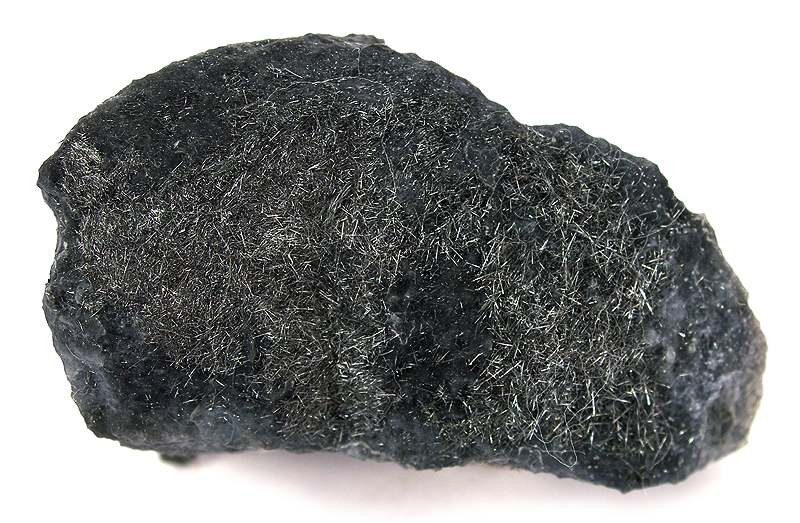
Dadsonite Locality: Saint-Pons , Ubaye valley, Alpes-de-Haute-Provence , Provence-Alpes-Côte d'Azur , France ( Locality at mindat.org ) Size: 3.8 x 2.3 x 1.7 cm. A rich specimen of this extremely rare lead/antimony sulfide which also contains chlorine in it. The surface is covered with acicular crystals, and the whole piece is probably massive dadsonite as well. Ex. Eric Asselborn and Alain Martaud Collections. — Photo: Robert M. Lavinsky · CC BY-SA 3.0
Dadsonite
Dadsonite is an IMA-recognized mineral species in the sulfosalt class, with the chemical formula Pb₂₃Sb₂₅S₆₀Cl.
It crystallizes in the triclinic crystal system (space group P-1). It is a member of the Dadsonite structural group.
Key properties: Mohs hardness 2.5; specific gravity 5.68; Black streak; Metallic. Anisotropism: Distinct to strong, in greenish gray. R1 –R2: (400) 44.0–46.6, (420) 42.3–45.8 luster.
IMA symbol Dad, IMA status: approved, named in 1968.
Found in hydrothermal veins with other sulfides and lead sulfosalt minerals.
It is found associated with Jamesonite (Northwest Territories and Ontario, Canada); robinsonite (Pershing Co., Nevada, USA); bournonite, boulangerite, zinkenite.
The mineral was named to honor the Canadian mineralogist, Alexander Stewart Dadson (1906–1958), active in development of the Yellowknife gold deposits.