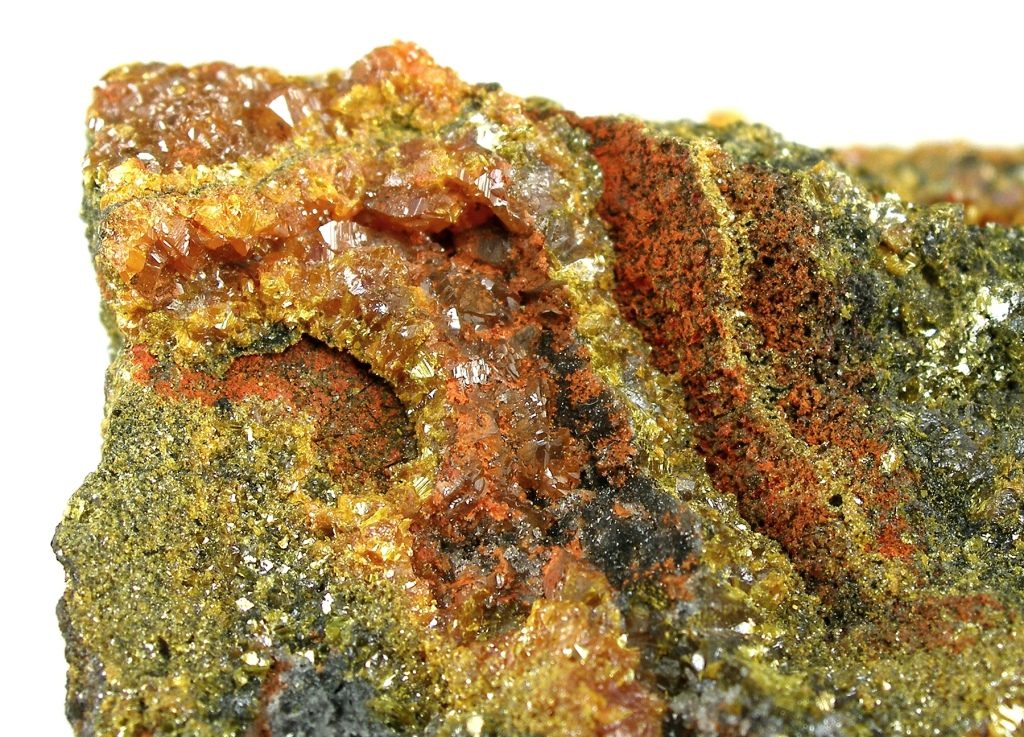
Daliranite , Orpiment Locality: Zareh Shuran Mine (Zarshuran Mine; Zarshouran Mine; Zarehehuran) , Takab (Takan Tepe) , West Azarbaijan Province , Iran ( Locality at mindat.org ) Size: 10.5 x 7.1 x 4.9 cm. Daliranite occurs as hair-like crystals, in appearance similar to ludlockite. This beautiful new species is a new sulfosalt from the Zarshouran Au-As deposit, Iran, published in late 2009. Only a small number of these pieces were recovered and then studied. This is one of the largest extant specimens and is co-type material, which I obtained by exchange from the collection of Dr. Werner Paar of the University of Salzburg. Dr. Paar is lead author on the publication of the species (Mineralogical Magazine, Oct. 2009, vol. 73 #5.) Daliranite occurs as very rich orange-red crystals, eye visible but sub-mm in size, easily seen on this contrasting matrix specimen of quartz. It is associated with orpiment and other related species (he has identified both galkhaite and cinnabar as present on this piece). This specimen is a large, display-worthy piece. The orpiment veins and crystals make this an attractive piece, overall. These specimens were found in 1998-2002 and studied only later, in Germany. Return trips by the authors in 2005, to the dumps, were unsuccessful at finding more daliranite and it remains today a fairly rare species, thus. Originally, and erroneously, reported as ludlockite from Zarehehuran, Takap, Takht-e-Suleiman massif, Azerbaijan. Apparently, it was rather difficult to analyze and presented a fair challenge to the crystallographers. Type and only locality material. Co-type material. — Photo: Robert M. Lavinsky · CC BY-SA 3.0
Daliranite
A vibrant orange-red lead-mercury-arsenic sulfosalt from northwestern Iran, once confused with the oxide ludlockite.
Intro adapted from Wikipedia (CC BY-SA).
Daliranite is an IMA-recognized mineral species in the sulfosalt class, with the chemical formula PbHgAs₂S₅.
It crystallizes in the monoclinic crystal system.
Key properties: Mohs hardness 2; specific gravity 5.93; Pale orange-red streak; Adamantine luster.
IMA symbol Da, IMA status: approved, named in 2007.
A late-stage hydrothermal mineral formed by reaction with orpiment in a Carlin-type, sediment-hosted disseminated Au-As deposit.
It is found associated with Orpiment, quartz, rarely with galkhaite, hutchinsonite and cinnabar.
The mineral was named to honor Dr. Farahnaz Daliran (b. 1953), mineralogist and economic geologist at the University of Karlsruhe, Germany, for her research on ore deposits in Iran.