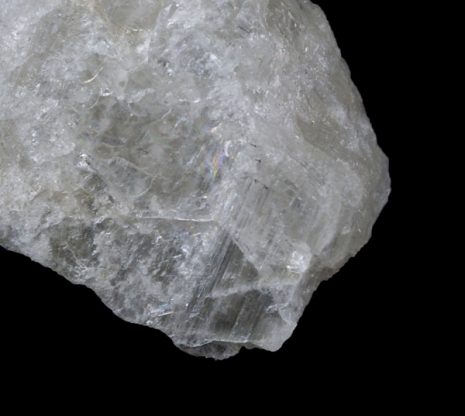
Darapskite (Size: 4.5 x 2.5 x 1.5 cm) Locality: Iquique Province, Tarapacá Region, Chile Darapskite is a rare hydrated sodium sulfate nitrate found in nitrate deposits rich in sulfates. The famous high altitude, arid nitrate deposits of Chile are host to many of the localities. Rarely available, this is a solid block of glassy, pearlescent, translucent and colorless, layered darapskite. Not showy, but an extremely rich and highly representative example of this very rare sulfate. Ex. Columbia University-American Museum or Natural History and Eugene Carmichael Collections. — Photo: Robert M. Lavinsky · CC BY-SA 3.0
Darapskite
Darapskite is an IMA-recognized mineral species in the nitrate class, with the chemical formula Na₃(SO₄)(NO₃)·H₂O.
It crystallizes in the monoclinic crystal system (space group P2_1/m).
Key properties: Mohs hardness 2.5; specific gravity 2.201; Vitreous luster; optically biaxial.
IMA symbol Drp, IMA status: approved, named in 1891.
Widespread in commercial nitrate deposits, filling veins and cavities in cemented regolith, in an arid region (Chile); in saline arid soil (Death Valley, California, USA; Antarctica); a component of “flowers” and other cave incrustations.
It is found associated with Nitratine, niter, blödite, mirabilite, epsomite, halite, anhydrite.
The mineral was named to honor Ludwig Darapsky (1857–1916), German–Chilean chemist and mineralogist, Santiago, Chile.