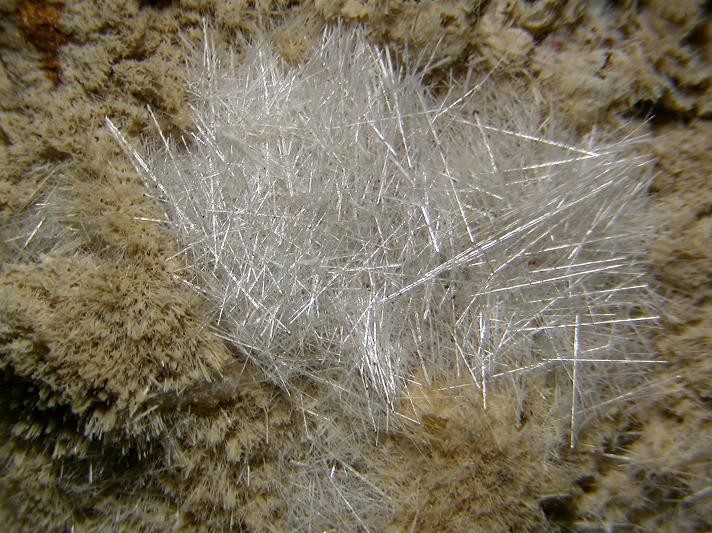
Dawsonite Locality: Terlano (Terlan), Adige Valley (Etsch Valley), Bolzano Province (South Tyrol), Trentino-Alto Adige, Italy Field of view 10 mm. Specimen and photo Leon Hupperichs. — Photo: Leon Hupperichs · CC BY-SA 3.0
Dawsonite
A sodium-aluminium carbonate hydroxide discovered in 1874 during construction of McGill University's Redpath Museum in Montreal.
Intro adapted from Wikipedia (CC BY-SA).
Dawsonite is an IMA-recognized mineral species in the carbonate class, with the chemical formula NaAl(CO₃)(OH)₂.
It crystallizes in the orthorhombic crystal system (space group Imma).
Key properties: Mohs hardness 3; specific gravity 2.436; White streak; Vitreous, silky in fibrous aggregates luster; refractive index 1.535; optically biaxial.
IMA symbol Dws, grandfathered status — known before the IMA’s founding, named in 1874.
Coating vug walls and fractures in hydrothermally altered feldspathic dikes and hornfels in association with nepheline syenite (Mont Saint-Bruno, Canada); authigenic in alkaline shales and coal-bearing rocks (Green River Formation, USA.
It is found associated with Fluorite, calcite, dolomite, aragonite, pyrite, quartz (Quebec, Canada); analcime, dolomite, quartz, calcite, pyrite, albite, cryolite, halite.
The mineral was named to honor John William Dawson (1820–1899), Canadian geologist and Principal of McGill University, Montreal, Canada.