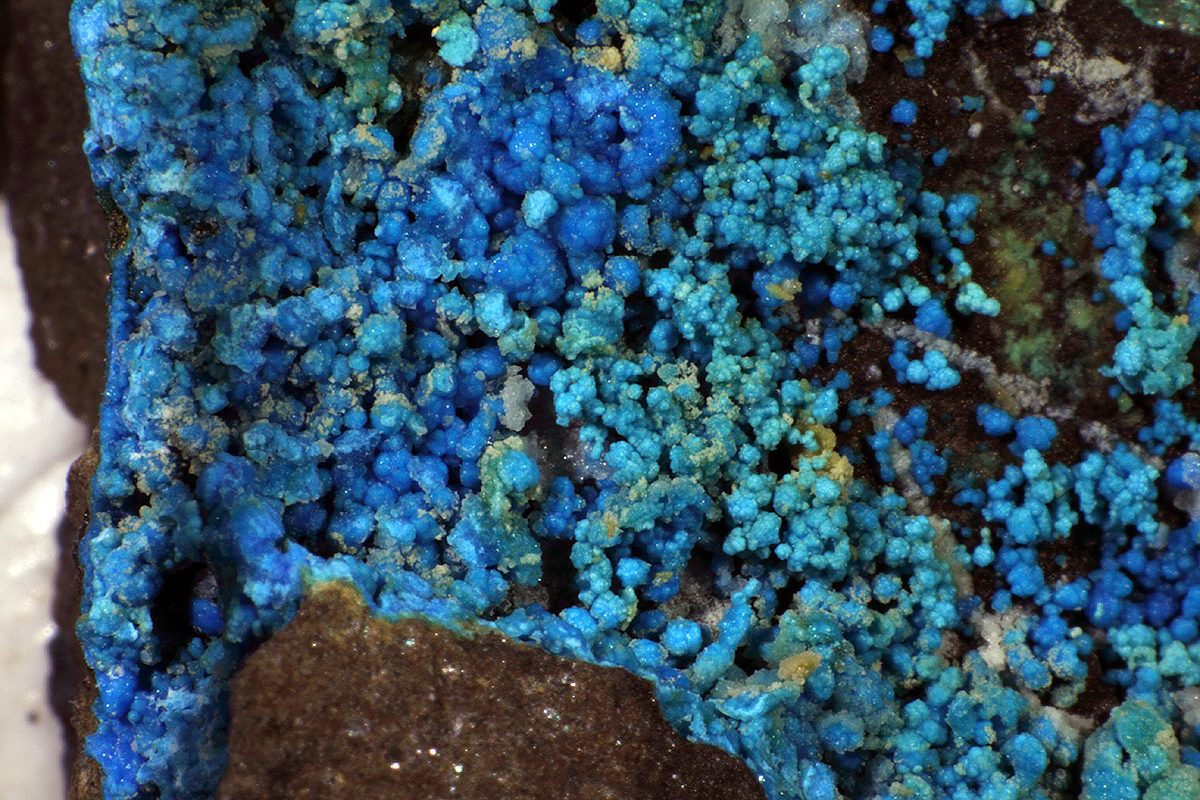
Near perfect formation of (blue) Decrespignyite-(Y) crystals creating botryoidal type formations with a small amount of (grey) Kamphaugite-(Y) — Photo: Mark Trevor Willoughby · CC BY-SA 4.0
Decrespignyite-(Y)
Decrespignyite-(Y) is a copper yttrium rare earth carbonate chloride hydrate; With a simple formula of; Cu(Y, REE)4(CO3)4(OH)5Cl · 2H2O Usually found as single pseudohexagonal platelets, often curved, and regularly measuring 10-50μm in size. It appears as royal blue to turquoise blue in colour, with a pale blue streak, and a pearly to vitreous lustre. Regarded as a supergene mineral which is believed to be formed through by mildly carbonated ground waters precipitating through the ore body. It is often associated with malachite, kamphaugite-(Y), donnayite-(Y) and caysichite-(Y).
Intro adapted from Wikipedia (CC BY-SA).
Decrespignyite-(Y) is an IMA-recognized mineral species in the carbonate class, with the chemical formula Y₄Cu(CO₃)₄Cl(OH)₅·2H₂O.
It crystallizes in the monoclinic crystal system.
Key properties: Mohs hardness 4; specific gravity 3.64; Pale blue streak; Vitreous to pearly luster; optically biaxial.
IMA symbol Dcp-Y, IMA status: approved, named in 2001.
A rare secondary mineral found in the oxidized zone of a copper deposit, the source of rare-earths enigmatic, perhaps from surrounding sediments.
It is found associated with Caysichite-(Y), donnayite-(Y), kamphaugite-(Y), malachite, nontronite, calcite, gypsum, “limonite”.
The mineral was named to honor Robert James Champion de Crespigny (1950–), Chairman of Normandy Mining Limited and Chairman of the South Australian Museum.