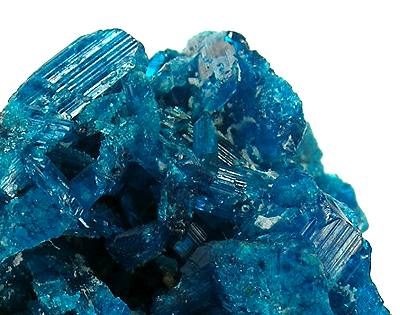
Caledonite , Diaboleite Locality: Mammoth-Saint Anthony Mine (Mammoth-St Anthony Mine; Mammoth Mine; St. Anthony Mine), St. Anthony deposit, Tiger , Mammoth District, Pinal County , Arizona , USA ( Locality at mindat.org ) Size: miniature, 5.0 x 4.2 x 2.6 cm Caledonite with Diaboleite The color of this caledonite is like nothing you could imagine, in person. It looks fake, like lab-grown copper sulphate but with metallic lustre. This is a frankly unbelieveable caledonite specimen of a richness I have never seen for sale on the market before. It is solid caledonite, with sharp crystals poking out all over, and with minor deeper blue Diaboleite crystals on the backside as a free bonus. It displays nicely, and presents so much stunning intense blue color that I had trouble believeing what I was looking at when I held this for the first time. My mind kept tellin gme it had to be caledonite on azurite - no caledonite could be so rich?! It is likely that this piece was mined prior to 1960. ex. American Museum of Natural History and was held since its deaccession by Larry Conklin in the Conklin Family Collection (specializing in such rarities in miiature size). It is an amazing example for the species but beyond that, an impressive, display-quality, historic US classic - its appreciably valuable from ANY angle of perspective in terms of history and significance and aesthetics, in other words. Even in the major Arizona collections, such a piece would be considered one of the capstones. — Photo: Robert M. Lavinsky · CC BY-SA 3.0
Diaboleite
A deep-blue lead-copper hydroxychloride discovered in England in 1923 — its name means 'distinct from boleite'.
Intro adapted from Wikipedia (CC BY-SA).
Diaboleite is an IMA-recognized mineral species in the halide class, with the chemical formula CuPb₂Cl₂(OH)₄.
It crystallizes in the tetragonal crystal system (space group P4mm). It is a member of the Perovskite structural group.
Key properties: Mohs hardness 2.5; specific gravity 5.42; Pale blue streak; Adamantine, pearly on cleavages luster; refractive index 1.916; optically uniaxial.
IMA symbol Dbol, IMA status: approved, named in 1923.
Found in oxidized manganese ores (Mendip Hills, England); a secondary mineral in deeply oxidized Pb-Cu ores (Tiger, Arizona, USA); in slag exposed to seawater.
It is found associated with Chloroxiphite, hydrocerussite, mendipite, cerussite (Mendip Hills, England); boleite, wherryite, hydrocerussite, leadhillite, phosgenite, caledonite.
Its name comes from the Greek for separate from, and the related mineral boleite.