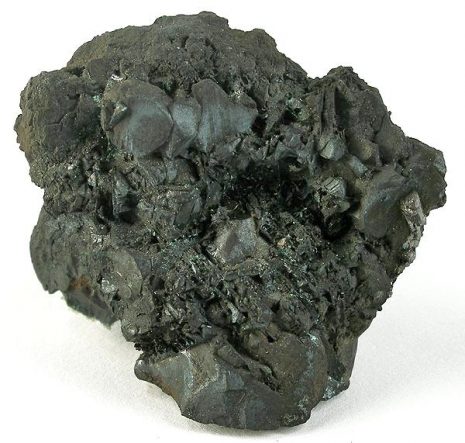
Digenite Locality: Butte , Butte District, Silver Bow County , Montana , USA ( Locality at mindat.org ) 4.2 x 3.8 x 2.2 cm. The world's finest crystallized digenite specimens have undoubtedly come from the famous mines at Butte and this is an excellent example from the Larry Krause Collection. The sculptural miniature is an intergrown cluster of sharp, moderately lustrous and lightly iridescent, dark-gray digenite crystals with typical rounded ends and terminations. The crystals have a green tint from a copper oxide coating or scattered bits of malachite. Essentially solid digenite, with only a bit of bornite and chalcopyrite on the back. Classic and highly representative material from this noted locale. — Photo: Robert M. Lavinsky · CC BY-SA 3.0
Digenite
A black-to-blue copper sulfide crystallizing in the trigonal system, usually massive but sometimes pseudo-cubic.
Intro adapted from Wikipedia (CC BY-SA).
Digenite is an IMA-recognized mineral species in the sulfide class, with the chemical formula Cu₁.₈S.
It crystallizes in the cubic crystal system (space group Fm3m). It is a member of the Digenite structural group.
Key properties: Mohs hardness 2.5–3; specific gravity 5.546.
IMA symbol Dg, IMA status: approved, named in 1844.
Found in hydrothermal copper deposits of primary and secondary origin. Formed under a wide range of conditions; reported from mafic intrusives, as a volcanic exhalation product, and in pegmatites.
It is found associated with Chalcocite, djurleite, bornite, chalcopyrite, other copper minerals, pyrite.
Its name comes from the Greek for two kinds or sexes, in reference to the presumed presence of both cuprous and cupric ions.