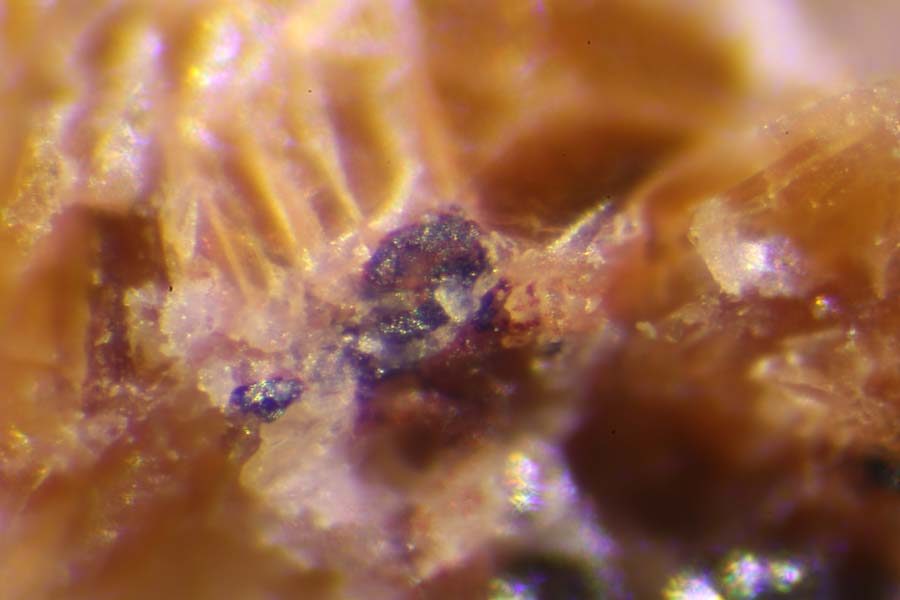
Dixenite is an extremely rare mineral known from only one locality worldwide, the famous Langban deposit in Sweden. The mineral is present in this specimen as dark red crystals associated to pyroaurite. This sample probably originates from the 1922 find (Irland working, 165m level) when dixenite was found associated to pyroaurite. Only two more dixenite occurrences are described in the literature, one from 1920 (the discovery) and later in 1924, so it is a real rarity! (Langban 1999 monography book, by D. Holtstam and J. Langhof) — Photo: David Hospital · CC BY-SA 4.0
Dixenite
Dixenite is an IMA-recognized mineral species in the silicate class, with the chemical formula Cu¹⁺Fe³⁺Mn²⁺₁₄(As⁵⁺O₄)(As³⁺O₃)₅(SiO₄)₂(OH)₆.
It crystallizes in the hexagonal crystal system (space group R3). It is a member of the Hematolite structural group.
Key properties: Mohs hardness 3–4; specific gravity 4.36; Metallic to resinous luster; optically uniaxial.
IMA symbol Dxn, grandfathered status — known before the IMA’s founding, named in 1920.
Found in a metamorphosed Fe{Mn orebody in serpentine.
It is found associated with Hematite, adelite, lead, domeykite, magnussonite.
Its name comes from the Greek di, for two, and xenos, for stranger, in reference to the then unique association of silica and arsenious oxide in the mineral.