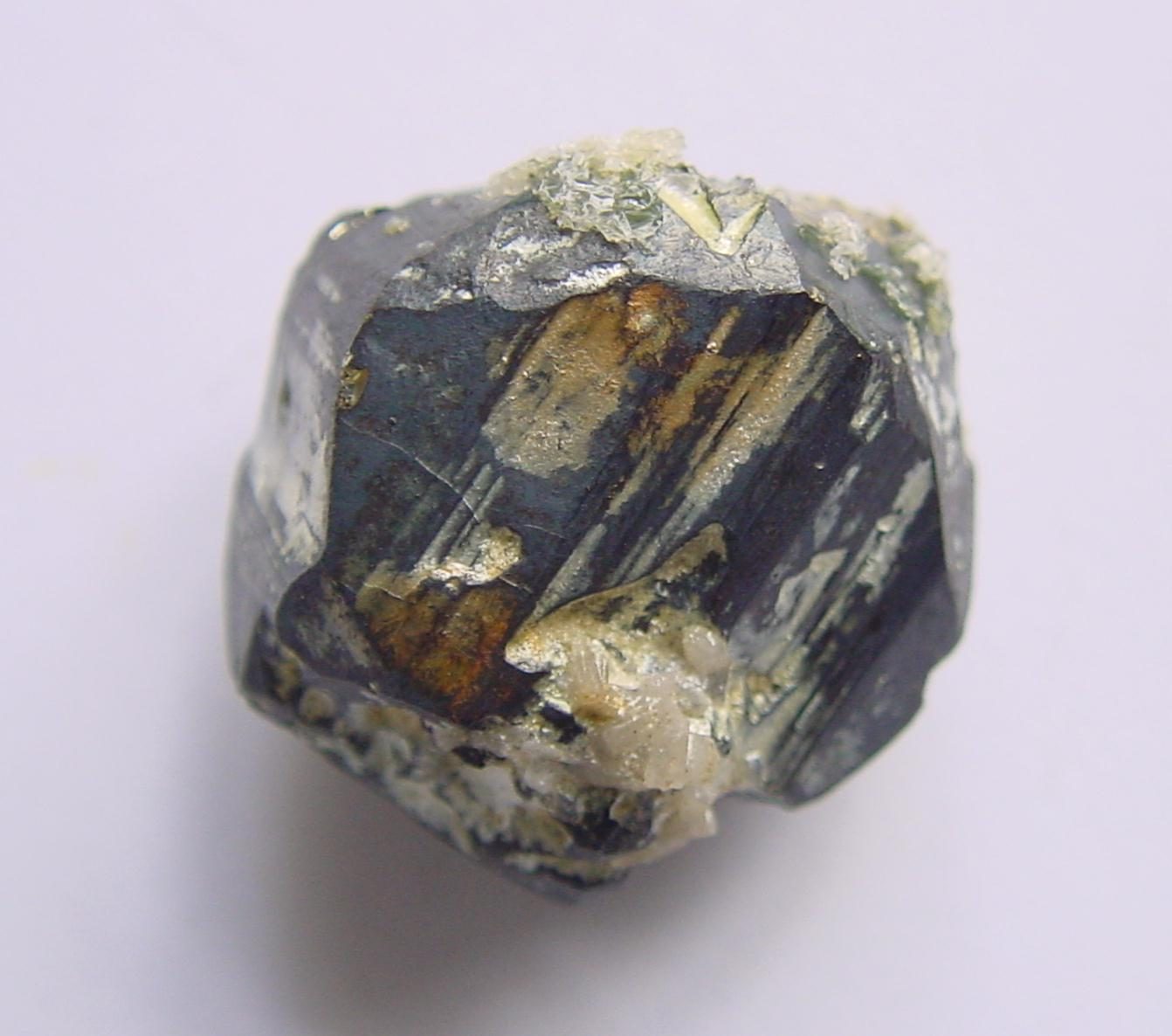
Djurleite pseudomorph after pyrite from Santa Rita, Grant County, New Mexico. Specimen size 2.4 cm. — Photo: Strickja · Public domain
Djurleite
A secondary copper sulfide of monoclinic symmetry, usually massive with occasional thin prismatic crystals.
Intro adapted from Wikipedia (CC BY-SA).
Djurleite is an IMA-recognized mineral species in the sulfide class, with the chemical formula Cu₃₁S₁₆.
It crystallizes in the monoclinic crystal system (space group P2_1/n).
Key properties: Mohs hardness 2.5–3; specific gravity 5.749; Metallic. Anisotropism: Weak. R1 –R2: (400) 36.1–37.3, (420) 36.2–37.1, (440) 36.0–36.8, (460) 35.7–36.4 luster.
IMA symbol Dju, IMA status: approved, named in 1962.
With other secondary copper sulfides in enriched zones.
It is found associated with Digenite, bornite, chalcocite, chalcopyrite, anilite, pyrite.
The name refers to Dr. Seved Djurle (1918–), Swedish chemist, who first synthesized the compound later found in nature.