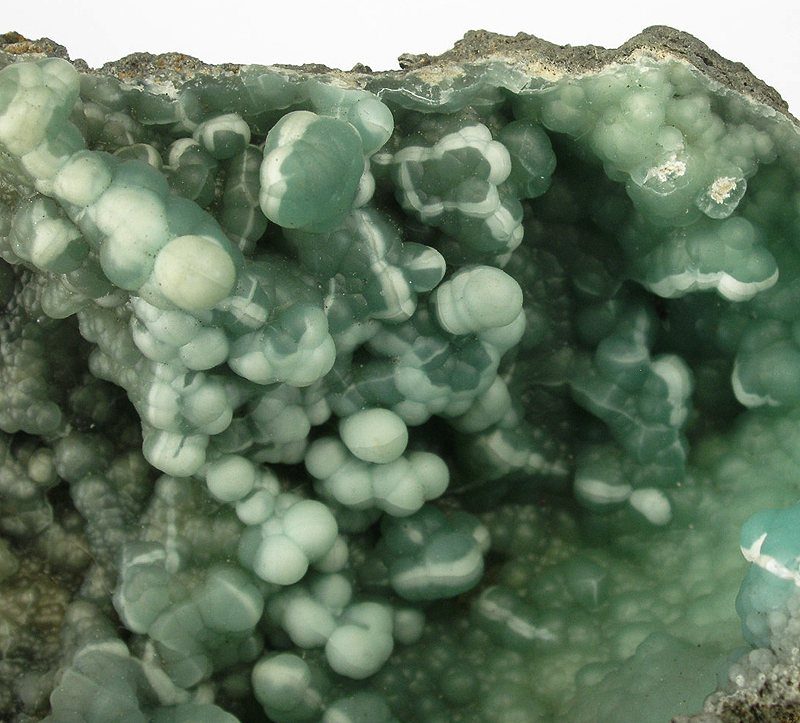
Doyleite , Gibbsite Locality: Xianghualing Mine (Hsianghualing Mine), Xianghualing Sn-polymetallic ore field, Linwu County , Chenzhou Prefecture, Hunan Province , China ( Locality at mindat.org ) Size: small cabinet, 9.6 x 7.2 x 5.8 cm Gibbsite with Doyleite Nestled in a vug are translucent, pastel blue-green botryoidal aggregates of gibbsite, to.8 cm in length, with interesting white overgrowths of the rare species doyleite. An aesthetic and complete pocket as found. — Photo: Robert M. Lavinsky · CC BY-SA 3.0
Doyleite
A rare aluminium trihydroxide described in 1985, named for Canadian physician and mineral collector Earl Doyle.
Intro adapted from Wikipedia (CC BY-SA).
Doyleite is an IMA-recognized mineral species in the oxides & hydroxide class, with the chemical formula Al(OH)₃.
It crystallizes in the triclinic crystal system (space group P-1).
Key properties: Mohs hardness 2.5–3; specific gravity 2.48; White streak; Vitreous to pearly if colorless; otherwise dull luster; optically biaxial.
IMA symbol Doy, IMA status: approved, named in 1980.
A late-stage hydrothermal mineral lining vugs in veins in nepheline syenite in association with an intrusive alkalic gabbro-syenite complex (Mont Saint-Hilaire, Canada).
It is found associated with Calcite, albite, pyrite (Mont Saint-Hilaire, Canada); weloganite, calcite, quartz, albite, pyrite, cryolite, strontianite, dresserite, dawsonite, fluorite.
The mineral was named to honor Canadian physician E.J. Doyle, of Ottawa, Canada, who found the mineral at Mont Saint-Hilaire, Canada.