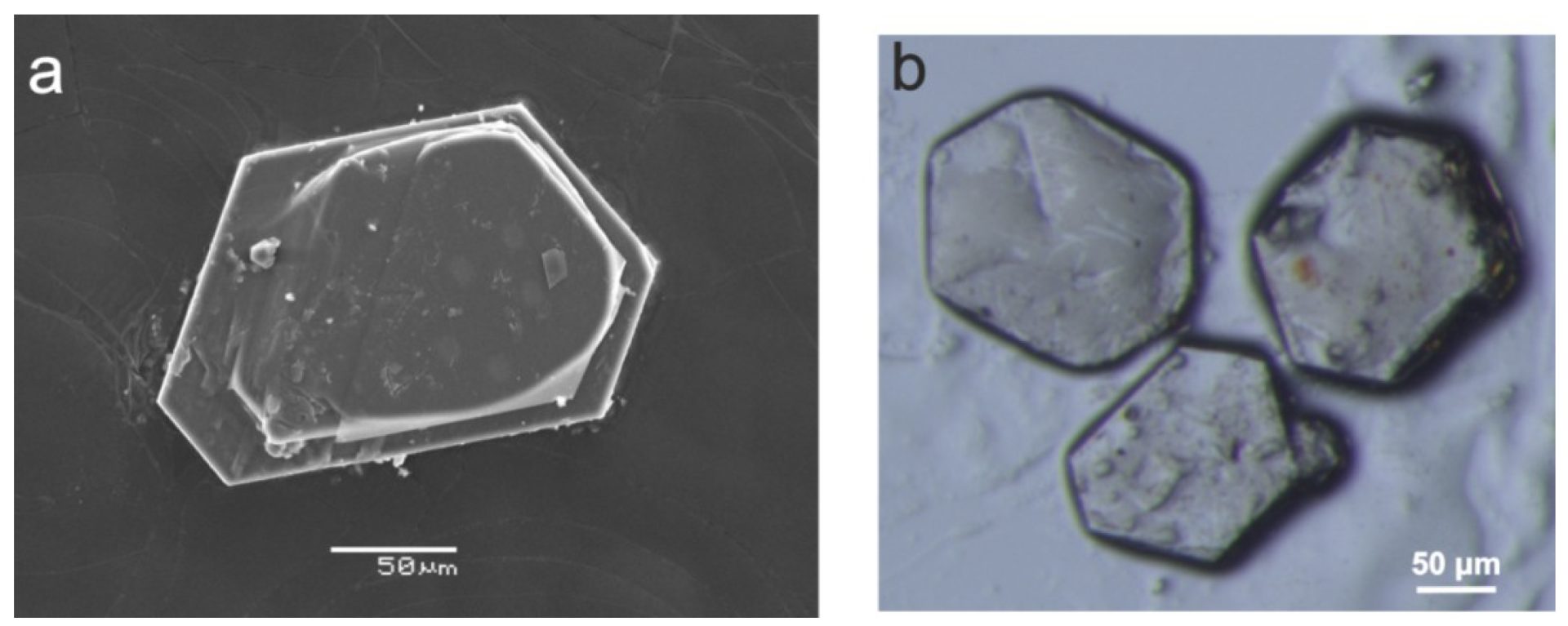
Crystals of dritsite: (a) secondary electron image; (b) photomicrograph in unpolarized visible light. This image is published in an open access article ( https://doi.org/10.3390/min9080492 ) distributed under the terms and conditions of the Creative Commons Attribution (CC BY) license ( https://creativecommons.org/licenses/by/4.0/ ). — Photo: Zhitova, Elena S. and Pekov, Igor V. and Chaikovskiy, Ilya I. and Chirkova, Elena P. and Yapaskurt, Vasiliy O. and Bychkova, Yana V. and Belakovskiy, Dmitry I. and Chukanov, Nikita V. and Zubkova, Natalia V. and Krivovichev, Sergey V. and Bocharov, Vladimir N. · CC BY 4.0
Dritsite
Dritsite is an IMA-recognized mineral species in the halide class, with the chemical formula Li₂Al₄(OH)₁₂Cl₂·3H₂O.
It crystallizes in the hexagonal crystal system (space group P6_3/mcm). It is a member of the Hydrotalcite structural group.
Key properties: Mohs hardness 2; specific gravity 2.123; White streak; Vitreous luster; optically uniaxial.
IMA symbol Drt, IMA status: approved, named in 2019.
A result of diagenesis in the halite-carnallite rock salt deposit.
It is found associated with Dolomite, magnesite, quartz, Sr-bearing baryte, kaolinite, potassic feldspar, krasnoshteinite, congolite, members of the goyazite-woodhouseite series.
The mineral was named to honor Russian crystallographer and mineralogist Professor Victor Anatol‘evich Drits (b. 1932), Geological Institute of the Russian Academy of Sciences, Moscow.