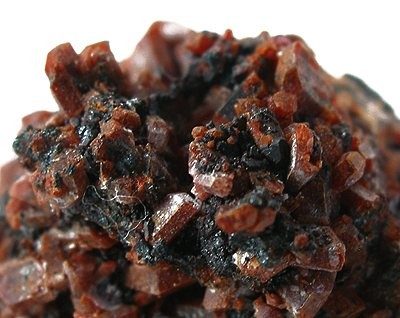
Durangite Locality: Thomas Range, Juab County , Utah , USA ( Locality at mindat.org ) Size: 2.2 x 1.8 x 1.5 cm. This is, for the species, exceptionally rich and with large crystals for the species. These red crystals to 2 mm sit on a mound of hematite, possibly the remains of a hematite after garnet, I have heard some say. The piece is showy and rich, with more color and larger crystals than on other samples I have seen (and I have only seen small thumbnails, mostly with sub-mm crystals, in the past). Obtained from the collector, John Holfert, approximately 10 years ago. — Photo: Robert M. Lavinsky · CC BY-SA 3.0
Durangite
Durangite is an IMA-recognized mineral species in the arsenate class, with the chemical formula NaAl(AsO₄)F.
It crystallizes in the monoclinic crystal system (space group C2/c). It is a member of the Titanite structural group.
Key properties: Mohs hardness 5–5.5; specific gravity 3.9–4.07; Cream-yellow to pale yellow streak; Vitreous, usually dull luster; optically biaxial.
IMA symbol Dur, grandfathered status — known before the IMA’s founding, named in 1869.
Found in veins in alkalic rhyolite and tin placers derived therefrom; in pegmatite dikes in granite.
It is found associated with Cassiterite, hematite, topaz, ilmenite, tantalite, wickmanite, beudantite, mimetite, fluorite, tridymite, cristobalite, quartz, amblygonite, “chalcedony”.
The name refers to the original occurrence in Durango, Mexico.