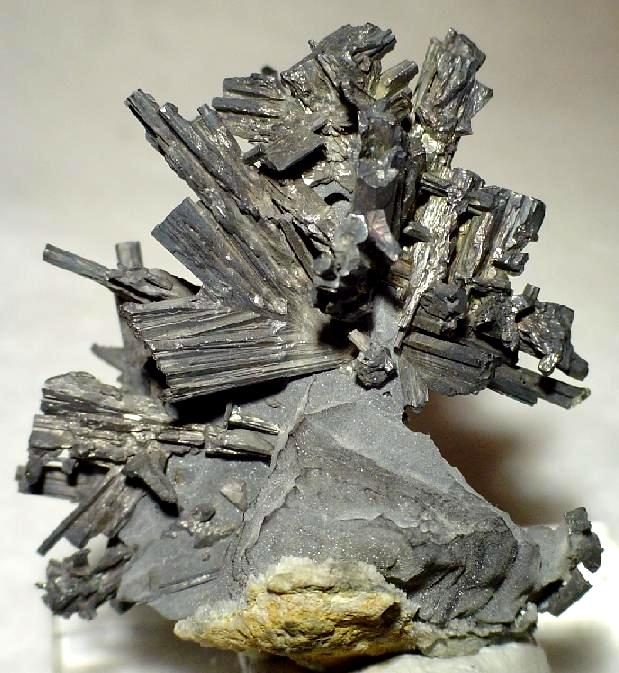
Dyscrasite Locality: Uranium Mine No. 21, Příbram , Central Bohemia Region, Bohemia (Böhmen; Boehmen) , Czech Republic ( Locality at mindat.org ) An excellent cluster of lustrous, twinned dyscrasite crystals with matrix. Some of the crystals reach 2.5 cm, and the twins to almost 2 cm. Although this is an old location from which dyscrasite was known a long time ago, many specimens on the market come from a few small pockets found in the 1980s. Most of these important specimens came out rather clunky, or so jumbly the crystals had little individual definition in context, but this miniature stands out amongst nearly all I have seen for the overall aesthetics and quality as well. 4.5 x 4.5 x 3.3 cm — Photo: Robert M. Lavinsky · CC BY-SA 3.0
Dyscrasite
Silver antimonide — a silver-white metallic mineral forming orthorhombic pyramidal crystals up to 5 cm.
Intro adapted from Wikipedia (CC BY-SA).
Dyscrasite is an IMA-recognized mineral species in the sulfide class, with the chemical formula Ag₃₊ₓSb₁₋ₓ (x ≈ 0.2).
It crystallizes in the orthorhombic crystal system (space group Pm2m). It is a member of the Allargentum structural group.
Key properties: Mohs hardness 3.5–4; specific gravity 9.712; Silver-white streak; Metallic luster.
IMA symbol Dys, grandfathered status — known before the IMA’s founding, named in 1832.
Found in hydrothermal veins with other silver minerals as both a primary and secondary mineral.
It is found associated with Silver, pyrargyrite, acanthite, stromeyerite, tetrahedrite, allemontite, galena, calcite, barite.
Its name comes from the Greek for a bad alloy.