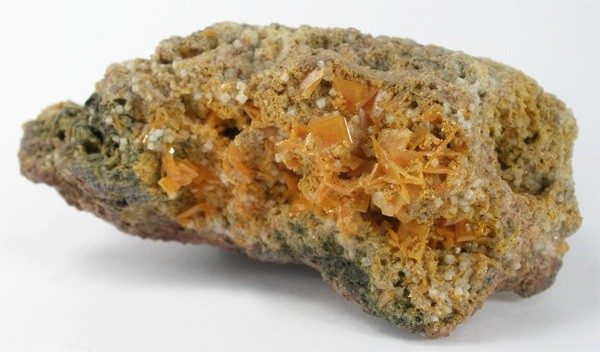
Wulfenite , Ecdemite Locality: Mammoth-Saint Anthony Mine (Mammoth-St Anthony Mine; Mammoth Mine; St. Anthony Mine), St. Anthony deposit, Tiger , Mammoth District, Pinal County , Arizona , USA ( Locality at mindat.org ) Size: 6.4 x 5.0 x 2.9 cm. Lustrous, butterscotch-colored wulfenite crystals to 5 mm richly fill two vugs on the gossan matrix on this old-time piece from the Mammoth-St. Anthony Mine at Tiger. Scattered about and best seen with a hand lens are tiny, colorless hairs to about 1 mm of the rare lead, arsenic halide ecdemite. Ex. Edna Doughty and Richard Hauck Collections. — Photo: Robert M. Lavinsky · CC BY-SA 3.0
Ecdemite
Ecdemite is an IMA-recognized mineral species in the halide class, with the chemical formula Pb₆As³⁺₂O₇Cl₄.
It crystallizes in the tetragonal crystal system.
Key properties: Mohs hardness 2.5–3; specific gravity 7.14; Vitreous on cleavages, greasy on fractures luster; optically uniaxial.
IMA symbol Ecd, grandfathered status — known before the IMA’s founding, named in 1877.
A rare mineral found in metamorphosed Fe–Mn orebodies (Sweden).
It is found associated with Heliophyllite, finnemanite, freedite, lead, copper, manganoan calcite, andradite, magnetite (Långban, Sweden).
Its name comes from the Greek for unusual, in allusion to the composition.