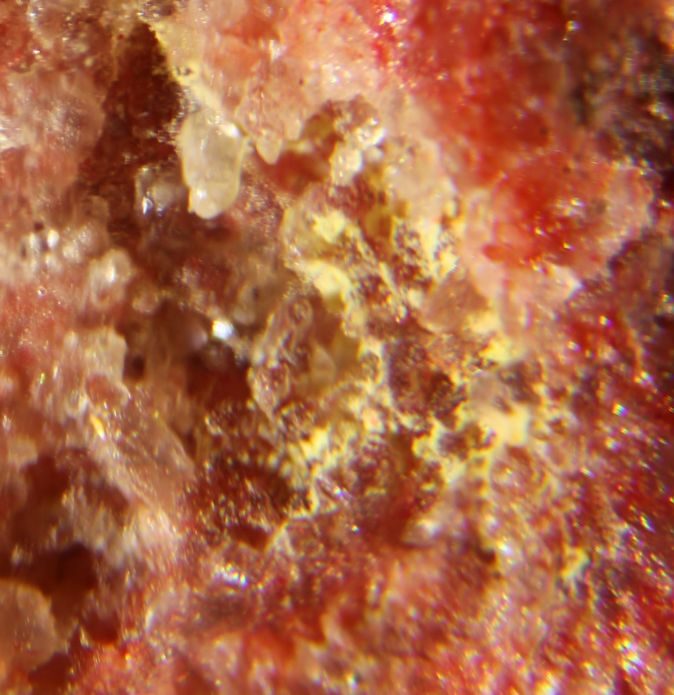
Yellow microcrystals of the rare Hg mineral eglestonite associated to cinnabar from Nevada: Cahill Mine, Poverty Peak, Humboldt County, Nevada, United States of America. Ex Vandenbroucke Museum collection from Waregem, Belgium. — Photo: David Hospital · CC BY-SA 4.0
Eglestonite
Eglestonite is an IMA-recognized mineral species in the halide class, with the chemical formula ([Hg¹⁺]₂)₃OCl₃(OH).
It crystallizes in the cubic crystal system (space group Ia-3d).
Key properties: Mohs hardness 2.5; specific gravity 8.31–8.45; Yellow or greenish yellow, rapidly becoming black streak; Brilliant adamantine to resinous luster.
IMA symbol Egl, grandfathered status — known before the IMA’s founding, named in 1904.
An oxidation product of other mercury minerals in mercury deposits.
It is found associated with Calomel, mercury, terlinguaite, montroydite, calcite (Terlingua, Texas, USA); cinnabar, mercury, calomel (San Mateo Co., California, USA); lavrentievite.
The mineral was named to honor Thomas Egleston (1832–1900), Professor of Mineralogy and Metallurgy, Columbia University, New York City, New York, USA.