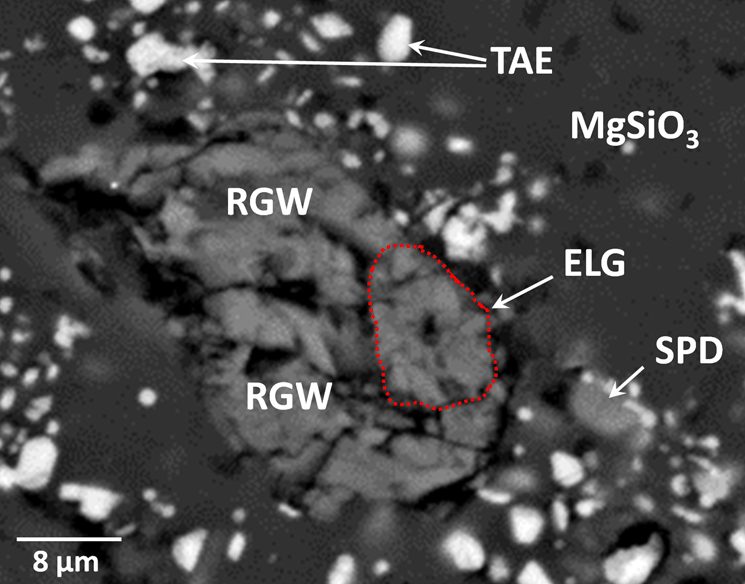
Scanning electron microscopy image of the newly found iron-magnesium silicate. Top: SEM-BSE panoramic image of the section containing new magnesium silicate (OL: olivine). The dashed lines indicate the walls of the shock-induced melt vein. The red rectangular area indicates the region enlarged in the bottom BSE image. Bottom: enlarged area depicted in the top panel; elgoresyite (ELG) [(Mg,Fe) 5 Si 2 O 9 ], indicated with the dotted red line, is associated with ringwoodite (RGW), olivine (OL), tetragonal ringwoodite (SPD), taenite (TAE), and MgSiO 3 -rich glass. The image is published in an open access article distributed under the terms and conditions of the Creative Commons Attribution (CC BY) license ( https://creativecommons.org/licenses/by/4.0/ ). — Photo: Bindi, Luca and Sinmyo, Ryosuke and Bykova, Elena and Ovsyannikov, Sergey and Mccammon, Catherine and Kupenko, Ilya and Ismailova, Leyla and Dubrovinsky, Leonid and Xiande, Xie · CC BY-SA 4.0
Elgoresyite
A high-pressure iron-magnesium silicate discovered in the shocked Suizhou meteorite — one of the rare deep-Earth mantle phases.
Intro adapted from Wikipedia (CC BY-SA).
Elgoresyite is an IMA-recognized mineral species in the silicate class, with the chemical formula (Mg₅Si₂)O₉.
It crystallizes in the monoclinic crystal system (space group C2/m).
Key properties: specific gravity 4.315.
IMA symbol Ego, IMA status: approved, named in 2021.
Found in a shock-induced melt vein in a chondrite meteorite. Suggested to be a potential constituent mineral in rocky planets with relatively high MgO + FeO content.
It is found associated with Ringwoodite, olivine, tetragonal ringwoodite, taenite, MgSiO3-rich glass.
The mineral was named to honor Dr.